
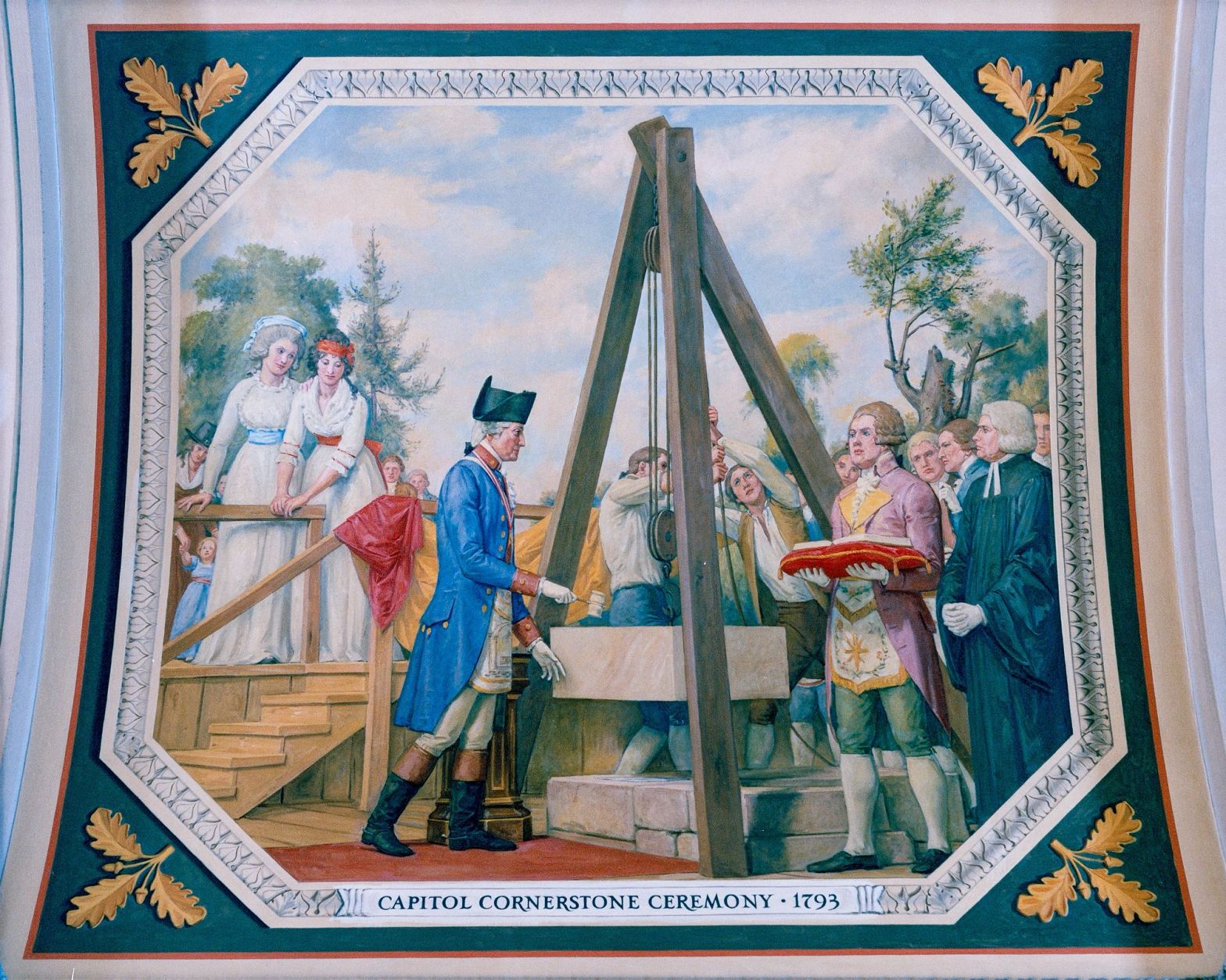
The United States originally had no permanent capital city under the Articles of Confederation. Even when the US Constitution was ratified, it included no mention of a national capitol. Congress met in eight different cities including New York, Philadelphia and Baltimore before 1791. In 1790, Congress passed the Residence Act, establishing the permanent seat of government along the Potomac River on a site to be determined by the nation’s first president, George Washington. He chose 10 square miles of land ceded by Maryland and Virginia.
The French engineer, Pierre Charles L’Enfant, laid out a grand plan for the capital city and its government buildings. L’Enfant designed the city to project the power and prestige. He envisioned a grand capital, built in the European fashion, with wide avenues, public squares, and inspiring buildings. The centerpiece of L’Enfant’s plan was a great “public walk.” Today that “public walk” has become the National Mall which stretches for two miles, from Capitol Hill to the Potomac River. At one end of this great public park, L’Enfant chose an elevated spot on what was then known as Jenkins’ Hill for the nation’s Capital. The hill was “a pedestal waiting for a monument,” he said.
Dr. William Thornton designed the capitol building to sit on this pedestal. Dr. Thornton designed a grand, two-winged structure topped by a central dome and construction in on September 18, 1793 with public laying of the cornerstone. The building would take nearly a century to complete. Work on the building was expensive and painfully slow. This was due in part to the cost of bringing the Aquia sandstone on boats up the Potomac – sometimes the stone would arrive unfit for use or the boats would be so overloaded they would sink. By the time House and Senate extensions were reconstructed in the mid-19th century, marble took the place of sandstone.
Freemasons have an elaborate ceremony for the laying of a significant cornerstone. The cornerstone a symbol of the sacrifices of labor and time necessary to build a moral and Masonic edifice. It also symbolizes sturdiness, morality, and truth. It is customary for Masons to lay the cornerstones of public buildings which they have designed or commissioned. The stone placed in the northeast corner of the foundation and is often hollowed out so that small objects can be placed inside, like coins, photographs, newspapers, or a list of those who erected the building. These cornerstones also traditionally show the date, the name of the Grand Lodge, the Grand Master, and the Masonic emblem.
Forty miles south of the Capitol, lays Government Island in Aquia, Virginia (Stafford Country). This hidden piece of land is the site from which the cornerstone to the US Capitol was quarried. This quarry provided Aquia sandstone for the construction of the White House and the U.S. Capitol Building. Pierre L’Enfant purchased Government Island on behalf of the federal government in 1791 to provide stone to build the nation’s new capital city.
Congress moved into the Capitol’s north wing in 1800. In 1807, the House of Representatives moved into the building’s south wing. Shortly after the working portions of the building were completed in 1811, the British invaded Washington DC and set fire to the Capitol on August 24, 1814. A rainstorm saved the building from total destruction. Congress met in nearby temporary quarters from 1815 to 1819. In 1861, construction was temporarily halted while the Capitol was used by Union troops as a hospital and barracks. Following the war, expansions and modern upgrades to the building continued into the next century.

On September 18, 1793, President George Washington, dressed in a traditional Masonic Apron, crossed the Potomac River and was met by two brass bands, a volunteer artillery company and a delegation of Masons from Virginia and Maryland. They escorted the commander-in-chief to what is now Capitol Hill in what would be the not-yet-a-city’s first parade. Before the stone was lowered into place, Washington placed an inscribed silver plate beneath the cornerstone at the southeast corner of the building. After the completion of the Masonic ceremony, a celebration was held including a barbecue. Festivities continued until dark.
The exact stone and the silver plate Washington laid have been lost to history. Multiple construction and repair projects have meant that the original foundations have been moved and upgraded many times. Today plaques mark the approximate location where that stone was intended to be placed.
Want to have the
Regimental Brewmeister
at your site or event?
You can hire me.
https://colonialbrewer.com/yes-you-can-hire-me-for-your-event-or-site/
 Michael Carver -- Historical Interpreter/Reenactor