
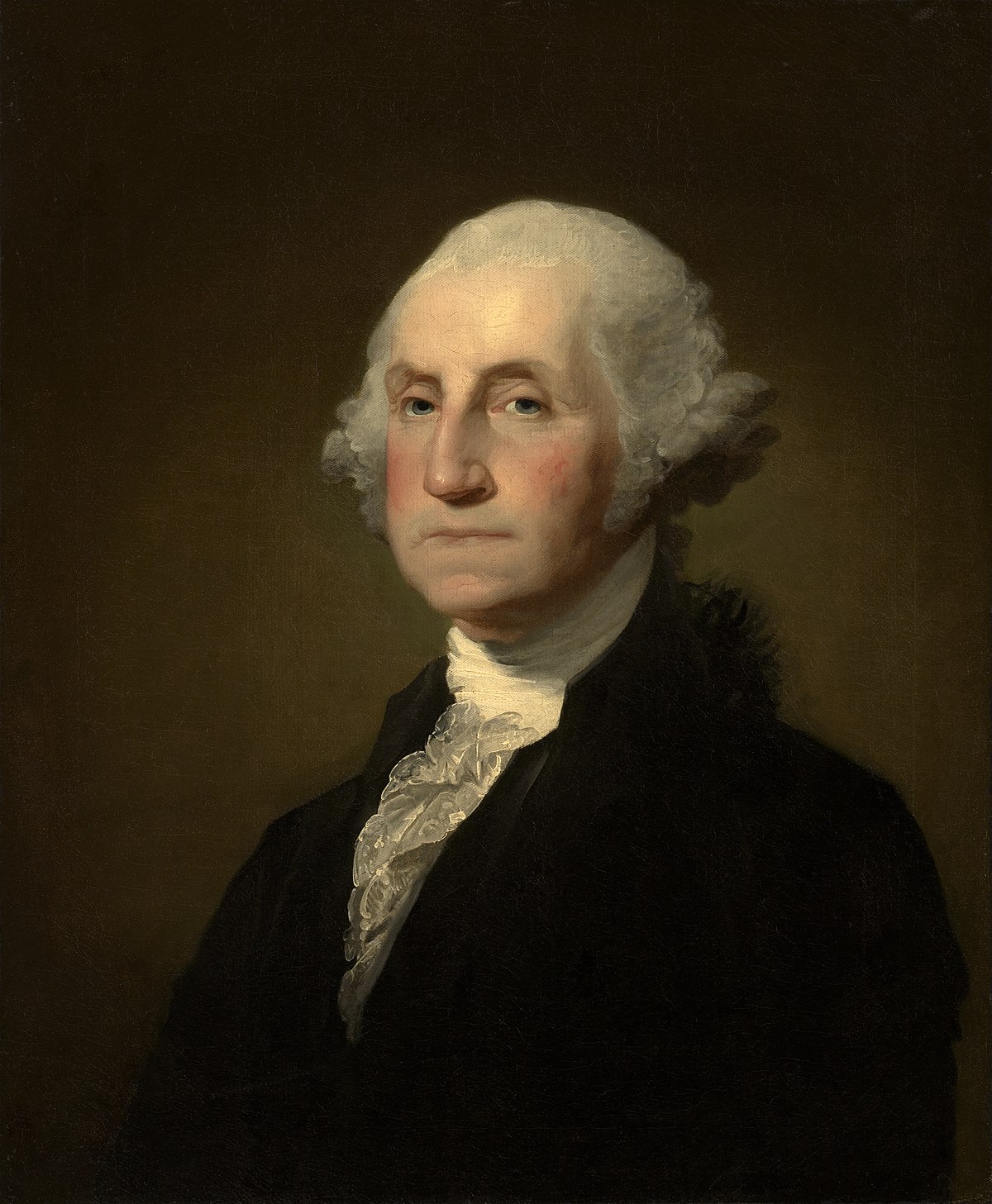
We applaud George Washington for his decision to end his presidency after two terms. The peaceful transition of power is the hallmark of American History and with only one exception, every president has chosen to follow Washington’s lead. George Washington helped unify the new nation and was a leading force behind the ratification of the Constitution. He oversaw the establishment of the nation’s capital, appointed the federal judiciary, and shaped foreign and domestic policy alike. Then, despite huge popularity, he stepped aside and allowed another, John Adams, president to be elected.
Washington was unanimously elected president of the United States in 1789. By 1792, Washington was frustrated by the emerging partisanship that was developing in the Congress. There was tension between the North and South, conflicts abroad, and policy disputes among his closest advisors, “The spirit of party serves always to distract the public councils and enfeeble the public administration. It agitates the community with ill-founded jealousies and false alarms, kindles the animosity of one part against another.” Washington had had enough. He didn’t want to serve a second term as president; He wanted to return to Mount Vernon. He also feared what would happen to the government in his absence. When cautioned by Alexander Hamilton that the country was too fragile to be in the hands of new leadership, Washington reluctantly agreed run. Again, his election was unanimous (the only person EVER to be unanimously elected) in 1792.
Most men who have served as President of the United States, appear to age dramatically in office. Most emerge from their terms with a head full of gray hair and all the physical hallmarks of a high-pressure job. It is no surprise that Washington died a few years (1799) after leaving office. The strife of the job, the bickering of his advisors. The Whiskey Rebellion, and administrative instability all marked the man with stress. These factors, coupled with the nearly a decade of hard military service all factored into his decision to walk away from the office. By 1796, Washington had had enough, he had given his life to the formation of the country and by the end of 1799, he died, completely used up by his new nation.
In reality, Washington may never have actually wanted to be president at all. Perhaps this is the mark of great leaders, the serve not for themselves but for others. In August 1788 as the new nation was electing its first leaders, Washington wrote a letter to Alexander Hamilton indicating he “should unfeignedly rejoice, in case the Electors, by giving their votes to another person would save me from the dreaded dilemma of being forced to accept or refuse.” By 1793, when the entire nation is joyfully celebrating his reelection, Washington is so unmoved by the event that he gave the shortest inaugural speech on record. Washington’s inaugural speech was a mere 135 words, expressing his thoughts on the position he was about to assume yet again:
Fellow citizens, I am again called upon by the voice of my country to execute the functions of its Chief Magistrate. When the occasion proper for it shall arrive, I shall endeavor to express the high sense I entertain of this distinguished honor, and of the confidence which has been reposed in me by the people of united America.
Previous to the execution of any official act of the President the Constitution requires an oath of office. This oath I am now about to take, and in your presence: That if it shall be found during my administration of the Government, I have in any instance violated willingly or knowingly the injunctions thereof, I may (beside incurring constitutional punishment) be subject to the upbraidings of all who are now witnesses of the present solemn ceremony.
1797 Inaugural Address
Washington’s second term was marked by huge conflicts and infighting.
- Thomas Jefferson and his Democratic-Republican party soon squared off against Alexander Hamilton and the Federalist party in a dance that continues today.
- Great Britain failed to relinquished its control over the Northwest Territories. Britain refused to give up forts within the land they’d handed over and the United States didn’t return property confiscated during the American Revolution.
- America’s ally, France, went to war with Britain in 1793 and expected the new United States to join their cause in the war. John Jay negotiated a treaty that kept the United States neutral in this conflict and suspended repayment of French loans but this would eventually lead to a cold war with France – the Quasi-War.
- America’s ally, France, had a democratic revolution of their own beginning in 1789, and Washington was pressured to provide some sort of assistance for the democracy-minded revolutionaries. The new nation was too poor and too fragile to survive a war in 1789 so Washington fought to remain neutral but was lambasted in the press for his position.
- As part of the deal to move the federal capital, the national government assumed states’ debts from the American Revolution. To pay off the debts, taxes were imposed on distilled spirits. Farmers throughout western Pennsylvania refused to pay the tax. Hostilities broke out almost immediately. Whiskey tax collectors were besieged and tarred and feathered, similar to how tax agents of the British Crown had been treated. Washington led an army of roughly 13,000 troops into western Pennsylvania to put down this rebellion (one of only two presidents to lead troops while in office[1].
- Cliques, secret societies, and political parties created distrust that pervaded politics in Philadelphia. All of these forces sought to destabilize rather than strengthen the union.
- Pirates along the Barbary Coast captured US shipping and enslaved American sailors. The United States tried to negotiate with the Algerians in 1792, but the latter chose to extort and ransom the captives instead. The US agreed to pay $642,500 for those held and $21,600 annually to ensure future sailors (but not the ships and cargos) would be captured.
- Political mudslinging in the newspapers, driven by divisions of the political parties, devolved into character assassination and Washington was often the target. Washington was criticized for lavish lifestyle, and when in private, Washington did enjoy luxuries of a standard similar to what he had at Mount Vernon. Washington was enraged especially when Democratic Republicans mad claims that the president and his supporters acted like monarchs.
- French minister Edmond-Charles Genêt came to Philadelphia looking for support for the revolutionary cause in France. Genêt hired privateers and organized actions against Spanish and British territories in North America and was eventually ordered to leave the United States or face prosecution. Washington demanded that France recall Genêt. Genêt refused to leave the United States, and launched a smear champaign against Washington and the US government in the press.
- Yellow fever broke out in the nation’s capitol and a huge panic followed suit. From late July to early November, between 2,000 and 5,000 people reportedly perished from yellow fever. Washington eventually ordered the capital moved from Philadelphia to nearby Germantown.
We laud Washington for stepping aside after two terms but the reality is much more complex. Political infighting, conflicts at home and abroad, character assassination, disease, and debt were more than enough drive him out. He gave everything to create a new nation and, as anyone who follows politics knows, the new nation did not appreciate his contribution until he was gone.
[1] The other being James Madison who rode into battle at Bladensburg to slow the British advance on Washington DC in 1814.
Want to have the
Regimental Brewmeister
at your site or event?
You can hire me.
https://colonialbrewer.com/yes-you-can-hire-me-for-your-event-or-site/
 Michael Carver -- Historical Interpreter/Reenactor