
Historic Rittenhouse Town
206 Lincoln Drive
Philadelphia, PA 19144
Saturday, February 8th
Join Historic RittenhouseTown for Tavern Night! Come join us as the buildings and grounds of our historic 18th-century homestead are transformed into a tavern from the 1770s, where the simple pleasures of good food, drink, and fellowship collide.
Tavern Night will feature an evening of storytelling and merriment, complete with 18th-century beer and cocktails and hearth-cooked food prepared in our Bake House. Patrons will be encouraged to learn the popular parlor games (like whist, shut-the-box, and farkle) and join in toasts and popular songs of the day.
Tavern tickets now on sale!
Advance tavern night package includes 2 drinks and 2 meals.
For Tickets, please visit https://rittenhousetown.us18.list-manage.com/track/click?u=1724e3e6651f9a9d83bc33f28&id=abcb0bd5b2&e=62b1ba4115

Outside the church, the tavern was the most important institution in most towns. Taverns were used as meeting places for political assemblies (like the militia or the courts). When people needed to conduct business meetings or hold markets, their choices were generally the church or the tavern. Since the Colonial Legislatures often offered inducements to tavern owners, they saw these businesses as “operating for the common good,” which ultimately meant that tavern meeting rooms could be appropriated for government business like courts, polls, and meetings of the militia. People relied on taverns as the primary means of spreading news and ideas. Newspapers and stories were often shared by travelers in taverns. As conflicts erupted between the Crown and her colonies in the 1760’s, it was in the taverns that men discussed their responses and ultimate aims. It was in the colonial tavern that the revolutionary spirit launched our nation. Without taverns, it is likely that the various colonies would have remained separate and subjugated to the greater British Empire.
“To drink at a table without drinking to the health of someone special, should be considered drinking on the Sly, and as an act of incivility.” – Poor Richard
Beyond good ale, cocktails, and punch, we provide the following entertainments you are likely to encounter were you to visit a tavern in 1770:
Competitive Toasting: Toasts would solidify the bonds of groups. Toasts add a competitive element of drinking. To give a proper toast requires courage, it’s sort of a mini performance, one that requires facing the chance of achieving great success, or stumbling over what you say. Toasting elicits laughter, dispenses well wishes, and venerates people, events, and ideas (like liberty).
Parlor Games: Just like today, people of the 18th Century enjoyed parlor and tavern games, often gambling. There are two primary types of parlor games: card games, and dice games but certainly some establishments, especially in London, also had draughts, backgammon, chess, darts and billiards. The aim of most tavern games is not to create a competition but rather an excuse to sit together and discuss the day’s news.
TAVERN GAMES SHARED AND TAUGHT:
- Crokinole: Crokinole is believed to be of Mennonite origins, so bringing it to Rittenhouse is nod to good bishop Wilhelm Rittenhouse. Players take turns shooting discs across the circular playing surface, trying to land their discs in the higher-scoring regions of the board, particularly the recessed center hole of 20 points, while also attempting to knock opposing discs off the board, and into the ‘ditch’.
- The Royal Game of the Goose: Royal Game of the Goose is one of the first board games to be commercially manufactured, thought to have originated in Italy during the 15th century. It is a race game, relying only on dice throws to dictate progression of the players.
- Shut the Box: Originating in 12th century Normandy, Shut-the-Bo is a dice game where players turn down a series of numbered tiles mounted on a hinged box.
- Cribbage: Created by the English poet Sir John Suckling in the early 17th century, cribbage is a card game where players attempt to score a target number of points, tracked on a scoreboard with pegs.
- Draughts: Draughts, also known as checkers, is a two-player strategy board game where players take turns moving and capturing pieces on a checkered board.
- Backgammon: Backgammon is a 17th-century English board game played with counters and dice. Players race to remove all their counters from the board.
- Chess: Dating back to 7th Century India, Chess is a masters’ game where two players attempt to capture their opponent’s king in a mock battle.
- Farkle: In the late 1300’s, and English nobleman, Sir Albert Farkle, went to Iceland and returned playing a game with dice where players threw “hands” consisting of pair, straights, and other combination. Often played by French sailors, Farkle is the predecessor to Poker but played with dice.
- Mancala: Originating in Judea around 5870 BCE, Mancala is best know as a game that arrived in America from northern Africa with the slave trade. The game was played by enslaved Africans to social skills. Players plant “seeds” in “pits” then remove harvest these seeds as they move across the board with their opponent attempting to block and capture these seeds.
- Captain’s Mistress: Legend claims that Captain Cook took along his mistress on three major voyages to keep him company. The “mistress” was actually a box game which is the predecessor to “connect four.”
- Nine Men’s Morris: Nine Men’s Morris is a strategy game from Egypt, originating around 1400 BCE. The two players Players try to form ‘mills’—three of their own men lined horizontally or vertically to capture sections of a board.
- Ring the Bull: Invented for Ye Olde Trip To Jerusalem, the oldest pub in Nottingham England, Ring a bull is a game where a ring on a length of string is swung in an arc with the aim of hooking onto a bull’s horn.
- Skittles: Skittles is a indoor pub version of historical lawn bowling, commonly known as nine-pin bowling.
- Dominos: Originating in 13th Century China, dominoes first appeared in Italy during the 18th century and quickly spread over Europe as a game played by sailors. Dominoes (also known as bones, cards, men, pieces or tiles) is a number matching game where opponents alternatively attach their tiles to a string of linked tiles. In British public houses and social clubs, the game is normally played in pairs (two against two) and is played as a series of “ends”. In each “end”, the objective is for players to attach a domino from their hand to one end of those already played so that the sum of the end tiles is divisible by five, often scoring on a cribbage board.
- Desktop Curling: Originating in 16th Century Scotland, curling is a predecessor to shuffleboard and traditionally played on ice. We bring that inside (where its warm) for a tabletop game played without brooms.
- Whist: Invented in 1674, Whist, (originally called Ruff and Honours) is a card game first “played on scientific principles” by gentlemen in the Crown Coffee House in Bedford Row, London. Whist was a popular game among the officer corps of both the American and British Armies during the American Revolution.
Sharing of news and current events: Because the roads were poor, travel in the 18th Century was difficult and slow but there were travelers and they came with news. Travelers also often brought their newspapers, pamphlets, and even books which when they had finished reading, they frequently left, or even loaned, at the tavern.
Glees and Tavern Songs: Glees and songs made for and about drinking are, of course, nothing new. Americans used drinking songs as a way to band together in ale and song. In the ultimate homage to a night of drinking, Francis Scott Key borrowed the tune of a bawdy British drinking song (“To Anacreon in Heaven”) about overindulgence and questionable relationship choices when he wrote “The Star-Spangled Banner.”
Bar Menu:
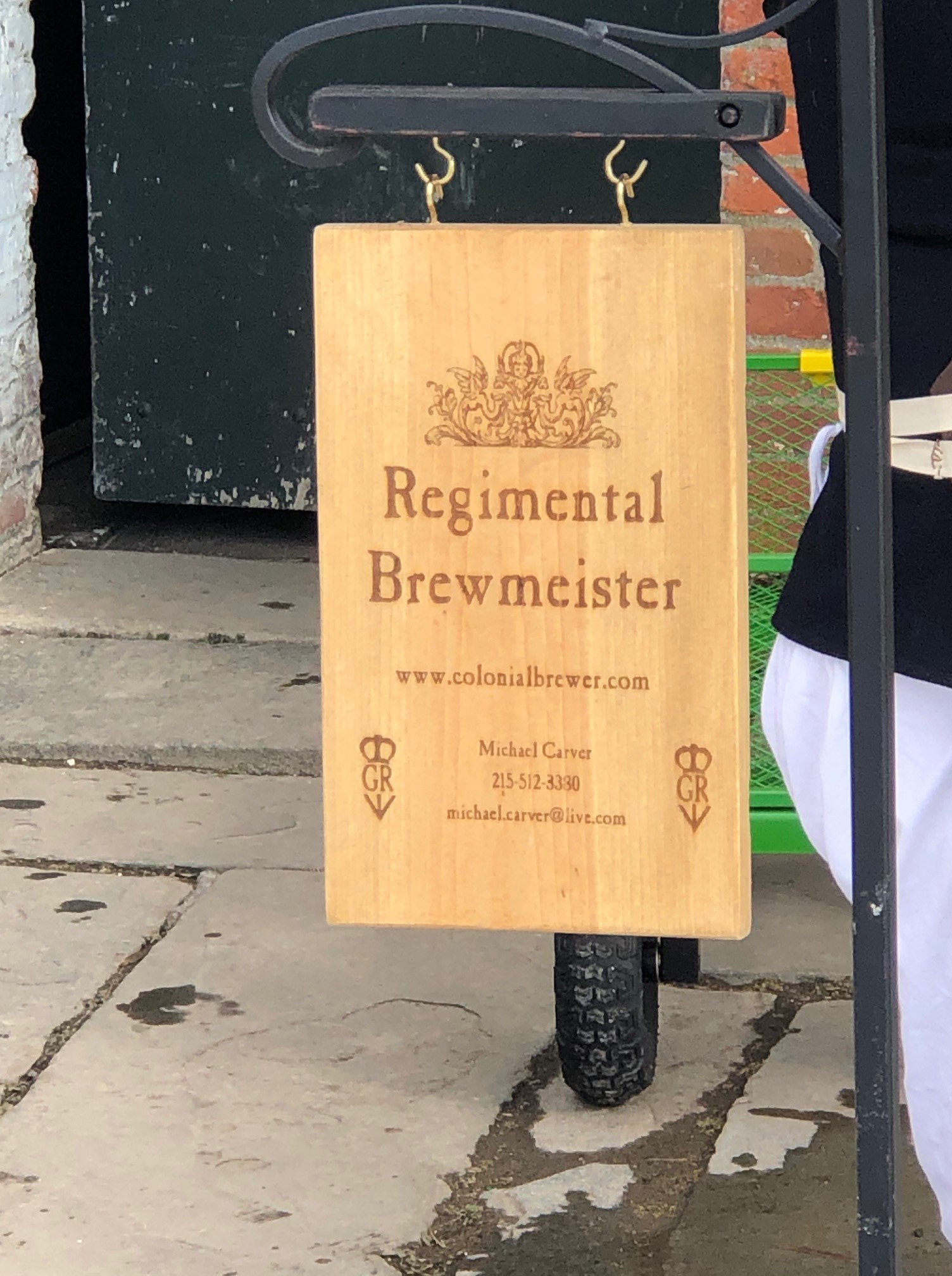
- Colonial Beer — We have Spruce Ale plus various specialty Beers by the Regimental Brewmeister all brewed over an open fire with 18th Century methods.
- Colonial Mead — Probably the world’s oldest alcoholic drink mead is fermented honey. Prior to the 1700s, mead was a popular choice of drink throughout New England. A Yankee favorite.
- Black Tea Punch — Punch (from the Hindi paantsch) was introduced to England by employees of the East India Company. This is a fine concoction of American Whiskey, Caribbean cane sugar, Indian Tea and lemon from Asia. A truly British cocktail.
- Fish House Punch — This punch is traditionally served by the Schuylkill Fishing Company in Philadelphia and described as “very kindly and welcomed . . . into their Province with a Bowl of fine Lemon Punch big enough to have Swimmed half a dozen of young Geese.” The Punch is traditionally made in a large bowl also used as a baptismal font for the citizens’ infant sons; “it’s an ample space … would indeed admit of total immersion…” According to legend, on a visit to the club, George Washington drank so much of the potent Fish House Punch, he subsequently couldn’t bring himself to make an entry in his diary for three days.
- Ale Flip — This is bartender drama at its finest. A true 18th Century tavern favorite Rum, eggs, beer and sugar. Served warm with a flair and heated with our logger-heads.
- Rattleskull — A perfect 18th Century Attitude Adjuster. Rum and spices mixed into a pint of beer.
- Cherry Bounce — A favorite of Mr. Washington. Whiskey infused with cherries. No Lies – it’s fantastic!
- Custom Cocktails – We will build you any cocktail that predates 1800. No Martinis or Cosmopolitan.
Want to have the
Regimental Brewmeister
at your site or event?
You can hire me.
https://colonialbrewer.com/yes-you-can-hire-me-for-your-event-or-site/
 Michael Carver -- Historical Interpreter/Reenactor