Saturday, July 8th
Independence National Historical Park
by the Commodore Barry Statue
in Philadelphia
11:00 – 4:00
(Multiple presentations)
The Regimental Brewmeister will try his hand at a 1st person impression – David Rittenhouse. In the world of Living History there are three distinct impressions people tend to assume when presenting people from the past. When we act as a third-person interpreter, we are just demonstrating what life was like at the time we are portraying. In third person interpretation, we openly acknowledge that this is the 21st Century and we are here, in historical dress, to help the visitors relate to the history they have come to learn. When we act as a first-person presenter, however, we assume the persona of the person we are presenting in its entirety and do not break character. The 21st Century does not exist. Obviously doing a first-person impression is hard.
When I do my 18th Century Brewer presentation, it is firmly a third-person impression. The advantage of third-person interpretation is that I can add modern context. This is particularly helpful when I get modern homebrewers who ask me questions. I can fluidly shift from 18th to 21st Century and explain what was understood and not understood in the 18th Century and how brewers had to compensate for these gaps. Ask me about the Plato of my beer when I am in my third-person mindset and I will tell you about how 18th Century brewers measured wort strength and we can discuss ABV. Ask me when I am in a first-person persona and I will look at you quizzically and say I don’t think that particular student of Aristotle really drank beer. Being in the third-person allows me to comment on the park as a museum, explaining which houses or artifacts may be original and where they came from, or what happened to the people who originally lived or worked in that building, and so on, which visitors are often keen to know. But Independence National Historical Park wants first-person presentations (the rangers or tour guides get to fill in the gaps).
Doing a first-person impression means I have to BECOME David Rittenhouse for an hour or so. I have to speak as he would and I am allowed to speak of only those things he would have known at the time. I am only allowed to break character in front of visitors if not doing so represents a safety or security risk (don’t worry, if someone collapses, David Rittenhouse has miraculous knowledge of CPR and the Rangers will handle the AED). When confronted with anachronisms (car horns and sirens, cameras and cellphone, etc.) I am to dismiss these things as impossible or perhaps fantasy and pretend not to understand anachronistic things that visitors tell me (NASA, what is this NASA? A man cannot possibly climb up to the Moon). Of course, in some cases, I can fall back to a BRIEF second-person presentation (You say you are from California? Oh, I love the Spanish…).
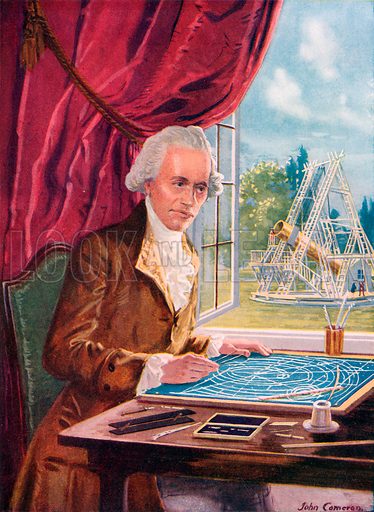
So, I plan to adapt my Transit of Venus program so that it will be delivered Mr. Rittenhouse. The Declaration of Independence will have just been read from the same dais that Rittenhouse spoke from when he told Philadelphia about his observations on Venus in 1761 and 1763 and why they were so important. Rittenhouse’s observatory was one of the few British observations to not be obscured by clouds. I will talk about how none of this would have been possible without the £100 grant provided by the Pennsylvania Assembly (who meet in the Statehouse). How I used this money for new telescopes, some with gratings made of spider’s webs to allow us to measure the speed of the transit, and a staff for the 22 telescope stations placed across Delaware, New Jersey, and Pennsylvania. I’ll even admit to fainting from the great excitement actually observing this very rare event with my own eyes. Finally, I’ll talk about how important knowing the distance from Earth to the Sun is for the Navy and how only in the British Empire (the sun never sets on the British Empire) could we have observers coordinated all over the globe to do this task (Lt Cook went to Tahiti). The I will rap up with a few comments on what an honor it is to be elected to the American Philosophical Society and Royal Society of London.
It should be fun but it may be terrifying… we’ll see. If this works out, I am also planning to develop presentations on:
- Haym Solomon — Jewish patriot and paymaster who manage to pay soldiers marching to Yorktown so they would not mutiny. Also a notable spy for the Continental Army.
- Major John Clark — Spy and officer in the 2nd Pennsylvania Regiment.
- Charles Mason — Partner to Jerimiah Dixon who were ordered by Parliament to settle the boarder between Pennsylvania and Maryland (Mason Dixon Line) to quell the Conojocular War. This may include bringing out the surveying gear.
- George Mason — One of four dissenters who helped write but refused to sign the US Constitution on grounds it has no Bill of Rights.
 Michael Carver -- Historical Interpreter/Reenactor