
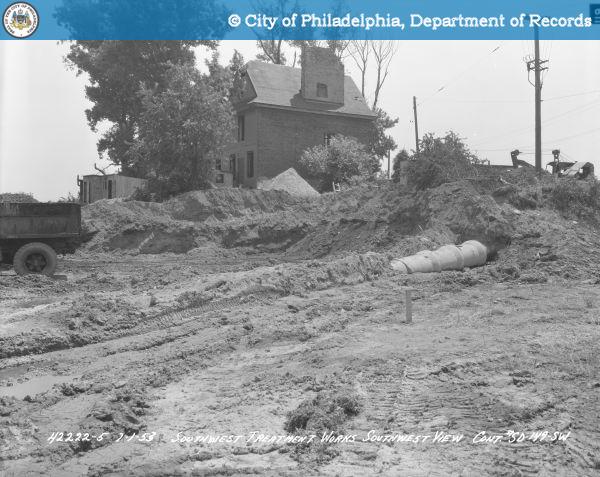
In the 1680’s Peter Cook build a small farmhouse on a plot of land nobody wanted. Laying claim to a small swampy parcel on Mud Island several miles form William Penn’s utopian “green country town” this Swedish settler thought he and his family would never be challenged for their little farm. The site proved good for farming, and provided well enough for the next owner to expand the farmhouse and this modest brick house stood quiet and alone for the better part of the 18th century. Then on November 11, 1777, a cannonball entered the rear wall of the old farmhouse, passed through and exited the front wall. From that day forward, old Swedish farmhouse would carry a new name: the Cannonball House.
Peter Cock couldn’t have picked a more off-the-beaten track location for his farmhouse. In the 1680s, and for a long time after, nobody wanted this swampy little plot at the confluence of the Schuylkill and Delaware rivers. Why would they? It regularly flooded. It was remote and hard to get to and there were flies. With so much rich, dry land in every direction of Philadelphia why would anyone want anything to do with Mud Island. All this would change in the 1760’s when Britian was at war with France.
By 1771, Philadelphia was the largest British city in North America and John Penn asked General Thomas Gage to send someone capable of designing defenses for the city. Gage assigned Captain John Montresor of the British Corps of Engineers to design a system of fortifications that could regulate traffic entering the city and Montresor proposed constructing a fort on Mud Island. Montresor chose Mud Island because it offered protection to both the Schuylkill and Delaware Rivers. Work began on the fort in 1772, but proceeded slowly and stopped with the outbreak of hostilities between England and her Colonies. By 1775 the Philadelphia militia had taken over the site and resumed construction on the fortifications. Mud walls and palisades were completed and chevaux de frise were sunk in the river.
The newly completed Fort Mifflin and her companion Fort Mercer presented a formidable obstacle. When General Howe decided to attack Philadelphia in 1777, he found that the fort he had ordered constructed would be a serious, perhaps insurmountable, obstacle to an amphibious attack (like was done in Brooklyn in 1776) so he sailed south and up the Chesapeake eventually landing at Elks Head (near Elkton MD) and marched to Philadelphia, engaging the American Army at Brandywine. Howe was successful in taking Philadelphia but this stubborn little fort on the Delaware kept the Navy from supplying his army during the occupation. It had to be removed and this resulted in the largest bombardment of the Revolutionary War, six British ships bristling with 209 cannon attacked this little fort but for nearly three weeks it would not yield. Peter Cook’s house was “collateral damage.”
For the next 219 years, the Cannonball House, a survivor of the siege would be treated with veneration, deference, and respect. Artists would sketch it; antiquarians would photograph it; and the Historic American Buildings Survey would document it. At the beginning of the 20th century, the now city-owned Cannonball House served as a “model farm” used for to demonstrate various agricultural techniques. Model farms were particularly popular during the 1930’s and 40’s as people moved away from the farms to more urban areas and lost touch with how food was actually produced. The Cannonball House became a popular “tourist destination.” Then in 1954 the city’s need for a new sewage treatment overwhelmed the need for demonstrative agriculture and the Cannonball House was subsumed by the Southwest Treatment Plant. But people still remembered the little house and hoped to save it from the wrecking ball.

By 1974, the now old 1950s sewage plant needed to expand. Philadelphia’s Cannon Ball House became a problem. Should it be preserved and saved as part of the nation’s bicentennial celebration or should it be demolished to make way for better sewage treatment. In 1974, the Philadelphia Historical Commission decided that the Cannonball House wasn’t important enough to be listed on the National Register. But it was too important to be demolished. The Commission urged it be moved to a new site across from the entrance to Fort Mifflin. And in 1975, the main section of the Cannonball House was lifted from its foundations and wheeled slowly down the road into Fort Mifflin’s very small would-be parking lot. This uprooted deteriorated structure was lost its admires and even the preservation-inclined architecture critic, Thomas Hine, remarked that the “Cannon Ball Farm House has little claim to our minds and hearts…it requires some bravery to choose to forget it.” Eventually in November 1996, the City of Philadelphia, in violation of its own review requirements, demolished the Cannonball House. Fort Mifflin got a new parking lot but history lost a survivor of the siege.
It seems the city really does not value its history when it comes to Fort Mifflin — that little fort that saved the American Revolution.
Want to have the
Regimental Brewmeister
at your site or event?
You can hire me.
https://colonialbrewer.com/yes-you-can-hire-me-for-your-event-or-site/
 Michael Carver -- Historical Interpreter/Reenactor