
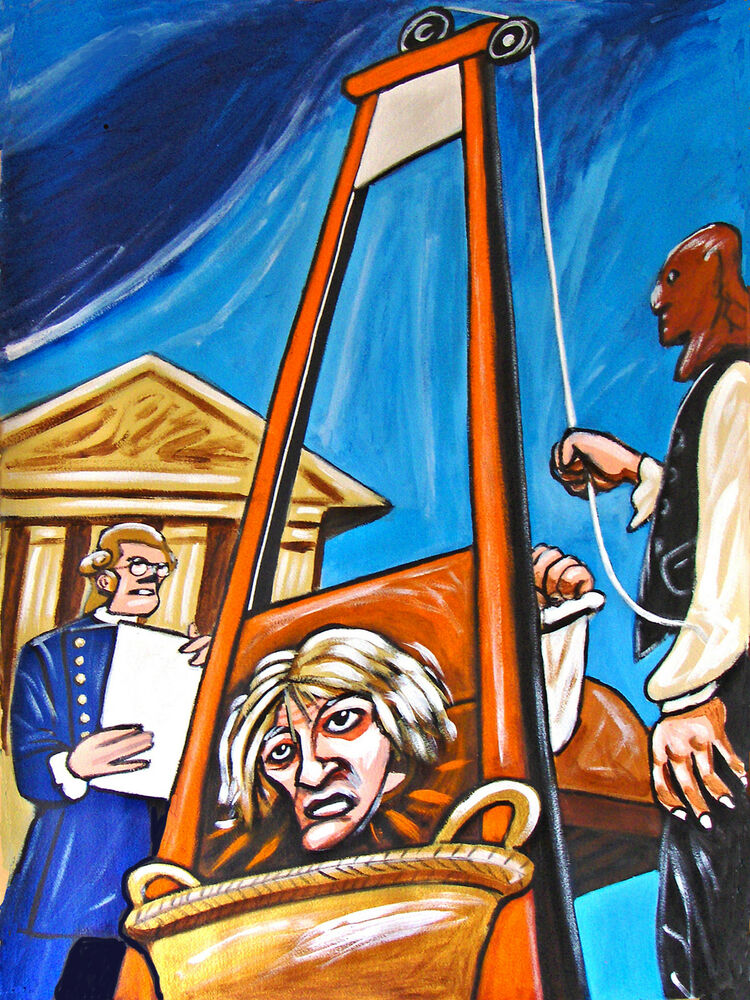
In the 8th Century BCE, King Hammurabi of Babylon codified the death penalty for 25 different crimes. The death penalty was also part of the 7th Century BCE Draconian Code of Athens and the 5th Century BCE Roman Law of the Twelve Tablets. Death sentences were carried out by such means as crucifixion, drowning, beating to death, burning alive, boiling, hanging, beheading, drawing and quartering, and impalement. For a short time in the 10th Century CE, we see a reluctance to execute criminals in that William the Conqueror would not allow persons to be hanged or otherwise executed for any crime, except in times of war. This trend did not last long and by the 16th Century, Henry VIII had as many as 72,000 people executed. In Britian it seems that almost all crimes were subject to the harshest penalties and by the 1700s, over 222 crimes were punishable by death in Britain.
Despite this penchant for harsh punishment, murder was so rampant in Britain during the mid-18th century, that Parliament sought to create ever more brutal responses in the law. The British Murder Act of 1751 became law was passed with the explicit purpose of terrorizing the public into a reasonable facsimile of human decency. These punishments for murder were designed not only to shame criminals in this life, but in the afterlife as well. They were purposefully Draconian and vindictive as evidence from the opening preamble of the Murder Act:
“WHEREAS horrid crime of murder has of late been more frequently perpetrated than formerly… it is thereby become necessary, that some further terror and peculiar mark of infamy be added to the punishment of death, now by law inflicted on such as shall be guilty of the said heinous offence.”
In addition to killing criminals for their crimes, Parliament sought to make an example to others in the process. Furthermore, once convicted, there was no recourse for an appeal. The law stated that a person found guilty of murder should be executed two days after being sentenced – unless the third day was a Sunday. Also, the Murder Act stipulated that the convicted could only be fed just bread and water once the sentence was passed. And the punishment did not end with the death of the convict.
The Murder Act stipulated that the dead person’s body should not be buried. In some instances, the corpse was hung in public places. This was meant to remind the populace what was in store for them if they committed murder. The other post-execution degradation was dissection by the town’s surgeons. These dissections could sometimes be public affairs, again focused on adding to the disgrace of the victim and his or her family and friends.
Britain influenced America’s use of the death penalty more than any other country. When European settlers came to the new world, they brought the practice of capital punishment. The first recorded execution in the colonies was in 1608 when officials executed George Kendall of Virginia for supposedly plotting to betray the British to the Spanish. In 1612, Virginia’s governor, Sir Thomas Dale, implemented the Divine, Moral, and Martial Laws that made death the penalty for even minor offenses such as stealing grapes, killing chickens, killing dogs or horses without permission, or trading with Indians. Seven years later these laws were softened because Virginia feared that no one would settle there.
Some colonies were very strict in their use of the death penalty, while others were less so. In Massachusetts Bay Colony the death penalty was meted out for pre-meditated murder, sodomy, witchcraft, adultery, idolatry, blasphemy, assault in anger, rape, statutory rape, manstealing, perjury in a capital trial, rebellion, manslaughter, poisoning and bestiality. By 1780, the Commonwealth of Massachusetts only recognized seven capital crimes: murder, sodomy, burglary, buggery, arson, rape, and treason.
The New York colony instituted the so-called Duke’s Laws of 1665. This directed the death penalty for denial of the true God, pre-meditated murder, killing someone who had no weapon of defense, killing by lying in wait or by poisoning, sodomy, buggery, kidnapping, perjury in a capital trial, traitorous denial of the king’s rights or raising arms to resist his authority, conspiracy to invade towns or forts in the colony and striking one’s mother or father (upon complaint of both). The two colonies that were more lenient concerning capital punishment were South Jersey and Pennsylvania. In South Jersey there was no death penalty for any crime and there were only two crimes, murder and treason, punishable by death in Pennsylvania.
The first reforms of the death penalty occurred between 1776-1800. Thomas Jefferson and four others, authorized to undertake a complete revision of Virginia’s laws, proposed that the death penalty be restricted to cases of treason and murder. After a stormy debate the legislature defeated the bill by one vote. Eventually, however, in 1793, the US Bill of Rights would include a provision against “Cruel and Unusual Punishments.” This was meant to match the severity of the crime with the severity of the punishment and end the idea of “some further terror and peculiar mark of infamy be added to the punishment of death.”
Because these punishments were horrific, juries tended not to convict when the penalty was great and the crime was not. In 1840, there was a failed attempt to abolish all capital punishment in Great Britian. Through the nineteenth and twentieth centuries, more and more capital punishments were abolished, not only in Britain, but also all across Europe, until today only a few countries (including the USA) retain the death penalty and even those countries that still demand death as a punishment for crimes no longer employ “cruel and unusual punishments.”
Want to have the
Regimental Brewmeister
at your site or event?
You can hire me.
https://colonialbrewer.com/yes-you-can-hire-me-for-your-event-or-site/
 Michael Carver -- Historical Interpreter/Reenactor