
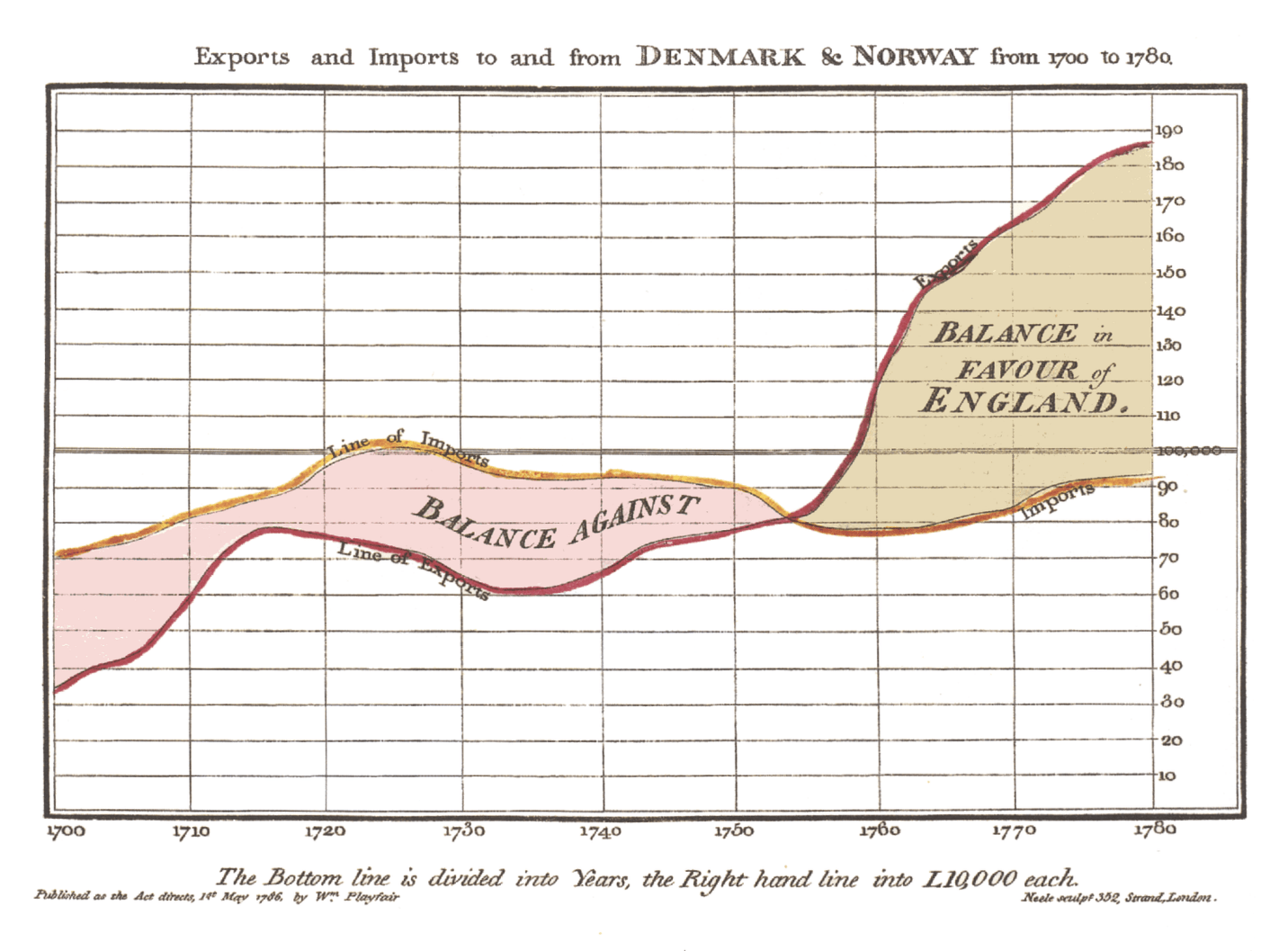
The bar chart, the pie chart, and the line graph were invented by a man who was, himself, something of a statistical outlier. William Playfair was a boundary-thwarting, Enlightenment-era, near-criminal rascal and 18th century academics actually looked down their noses at anything that resembled a picture arguing that “Readers were accustomed to persuasion by rhetorical means.” Well-written arguments, with perhaps a table or two, were what the educated elite expected in serious discourses. Illustrations were thought of as inaccurate “trifles,” suited more for decorating the publication rather than presenting facts and figures.
Playfair had little regard for tradition. His graphical inventions were inspired by a certain disrespect for limits. Inspired by his older brother John, an eminent mathematician and geologist, William Playfair learned that anything that can be expressed in numbers could also be represented with a line in Cartesian space. As a child. John had William check the thermometer outside their village home, then mark down the temperature readings on a big chart. After he left home in his late teens, Playfair became an apprentice with the engineer James Watt. He served as Watt’s draughtsman and clerk, copying complex drawings of Watts steam engines and other inventions.
Playfair parted ways with Watt in 1781, and tried his hand at many trades and get rich quick schemes. He was a silversmith, he entangled himself in a scheme to blackmail a Scottish lord (he believed the man had purchased his heirs). He went to France at about the time of the Revolution then went to to settle on American land tracts he didn’t actually own. In 1786, he published The Commercial and Political Atlas, a compendium of bar and line charts representing different European countries’ imports, exports, wages, and other trends for which he had the data handy.

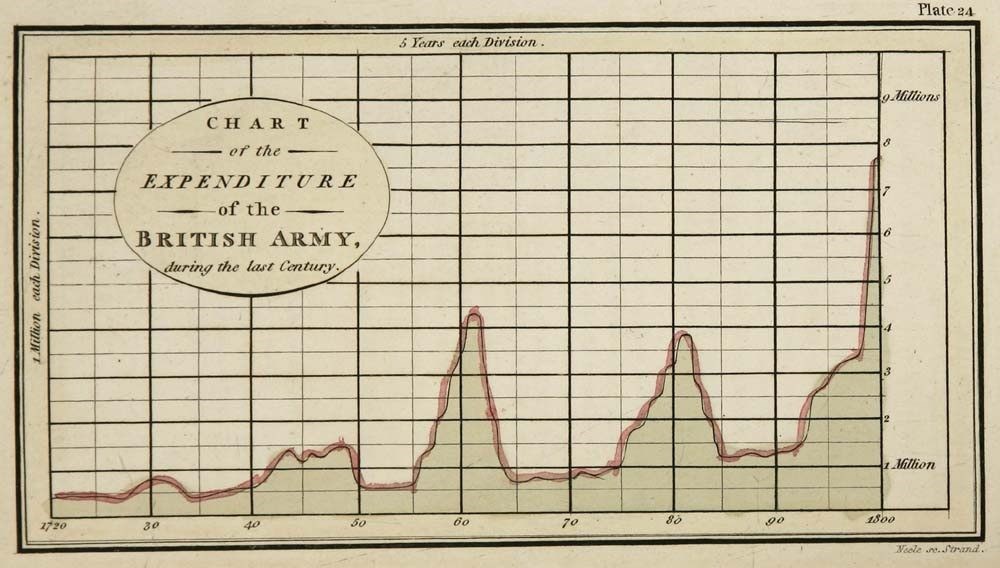

Like many of today’s charts, Playfair’s plots juxtaposed two sets of facts in order to tell a story; they were designed to help people understand complex issues at a glance. “As the knowledge of mankind increases, and transactions multiply, it becomes more and more desirable to abbreviate and facilitate the modes of conveying information,” he explained. “Men of high rank, or active business, can only pay attention to outlines… It is hoped that, with the Assistance of these Charts, such information will be got without the fatigue and trouble of studying the particulars.”
Playfair followed up in 1801 with The Statistical Breviary, which, along with more bar and line graphs showing the state of Europe, boasted a new invention: the pie chart. Aiming to illustrate the Turkish Empire’s landholdings, Playfair divided a circle into three proportional slices, each corresponding to a different continent. He then hand-colored the pieces: red for Europe, representing its strength as a land power, green for Asia, to represent its naval prowess, and yellow for Africa, for reasons lost to time (this decision also made him the first to color-code a chart).

Most academics at the time dismissed these publications, “because geometrical measurement has not any relation to money or to time.” As a consequence, Playfair died in poverty and obscurity 1823. Today, these innovative depictions of data are mainstays. Bar, line and pie charts allow us to digest huge amounts of data rapidly and as the amount of data in our lives increases, we are more and more dependent upon William Playfair’s shorthand communication of these numbers.
Want to have the
Regimental Brewmeister
at your site or event?
You can hire me.
https://colonialbrewer.com/yes-you-can-hire-me-for-your-event-or-site/
 Michael Carver -- Historical Interpreter/Reenactor