
When reenacting or acting as a historical interpreter, its good to have a few historical dates and stories to share. This series will publish a few.
December 19, 1776 The Second Night of Hanukkah at Valley Forge
On December 19, 1777 General Washington and his Continental Army arrived at Valley Forge. Many of the General’s troops were barefoot, starving, and dying from exposure. The General was probably pretty depressed. Washington had the habit of walking amongst his men. One night he saw a glimmering light glowing a private’s face. The man sat apart from the others huddled over two tiny flames.
For centuries, the lights of the Hanukkah menorah have inspired hope and courage. They may have also been responsible for inspiring then-General George Washington to forge on when everything looked bleak when his cold and hungry Continental Army camped at Valley Forge in the winter of 1777. One night Washington approached Private Asher Pollock of the Second Rhode Island Battalion. “What are you doing, Private?” “It is Hanukah, sir,” the Private said. “A thousand years ago our Temple was seized by Syrian-Greek soldiers who dedicated it to the worship of Zeus. Soon after, their emperor, Antiochus, made the observance of Judaism punishable by death. We were ordered to worship Greek gods.” Washington kneeled next to Asher and the flickering candles. “What happened?”
“Mattathias, a rabbi, refused to cooperate with the Greeks. He and his sons hid in the hills surrounding Judea. These rebels became known as the Maccabees. Eventually, they retook the land from the Greeks.” “So why the candles?” Washington asked. “The Maccabees wanted to consecrate the Temple in G-d’s name, but only had oil for one day. They lit it anyway expecting it to go out before more oil could be found. That day supply lasted 8 days.”
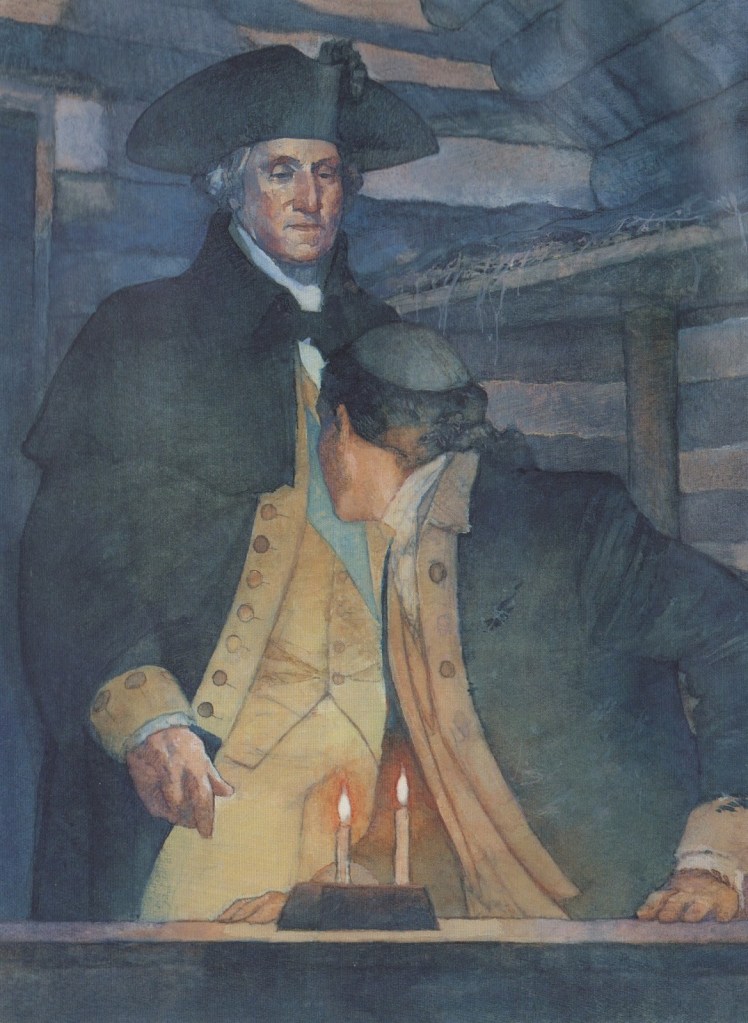
“You’re a Jew from a nation of prophets. You say we will be victorious?” “Yes sir,” Private Asher Pollock said. “We will beat the British like the Maccabees beat the Assyrians.” General Washington stood; his face shone anew. He shook Asher’s hand vigorously and disappeared into the darkness.
Years later, Asher Pollock met President Washington in the new independent American capitol of New York City. President George Washington came to his home and said “Behold, the wonderful candle. The candle of hope of the Jewish People.” The General placed his hand upon my shoulder and said, “This light and your beautiful words lit a flame in my heart that night. Surely, you and your comrades will receive due recognition for all of your valor at Valley Forge. But this night, accept from me, this medallion.” He hung the medallion of gold upon Asher’s and shook his hand. Inscribed on the medallion were the following words: “This candle and your inspiring words at Valley Forge ignited a light in my heart that night. A token of gratitude for the light of your candle.” -George Washington.
While some might question the veracity of the story, because the details of the Jewish soldier’s identity may be lost in time, here are its “truths:” Like generations of Jews before him, that soldier served as a “light unto the nations” (Isaiah 42:6), bringing inspiration and courage to a nation in its birth pangs. And he did so in a perfectly American way, a way in which a miracle did result, the miracle by which the light from one religion helps give comfort and courage to another.
Want to have the
Regimental Brewmeister
at your site or event?
You can hire me.
https://colonialbrewer.com/yes-you-can-hire-me-for-your-event-or-site/
 Michael Carver -- Historical Interpreter/Reenactor