
The Hawaiian flag still has a union jack in its canton and we often celebrate Captain James Cook as a great English explorer who discovered the Hawaiian Islands. Cook was a great explorer and scientist and he is known for his discovery of New Zealand, Tahiti, the observations of the Transit of Venus in 1769, as well as the use of citrus to prevent scurvy. He was also a kidnapper whose attempt to imprison members of the Hawaiian Royal family ultimately led to his death.
James Cook was the son of a Scottish farmhand. When his father became a foreman on a farm, his employer saw that Cook, who he found to have a curious and brilliant mind. Because of this, Cook was given a formal education paid by his father’s employer. James then became an apprentice with a chandler in the coastal village of Whitby. Fascinated by ships, Cook arranged for his apprenticeship to be transferred to a Quaker shipowner, John Walker. By age 21, Cook had become a rated seaman. In 1752, he was offered the command of one of Walker’s barks, but Cook turned down the offer and enlisted in the Royal Navy. Hoping for a more exciting career and greater opportunities at sea, Cook quickly rose through the ranks and by age 29, was appointed master of the HMS Pembroke. He also saw action during the Seven Years War at the battle in the Bay of Biscay,
As a sea captain, Cook mastered charting and surveying and these skills landed him a very important post as commander of the Royal Society’s scientific expedition in 1769 to chart the Transit of Venus. During this voyage, Cook found the southern continent known as Terra Australis, Tahiti, and New Zealand. He also took critical measurements and observations of the Transit of Venus needed to compute the Astronomical Unit (distance of Earth from the Sun). Upon his return to England, Cook was promoted to captain and inducted as a fellow in the Royal Society, earning the Copley Medal for his paper to help sailors avoid scurvy. He then started another voyage into the Pacific’s uncharted regions, ultimately discovering the Hawaiian Islands.
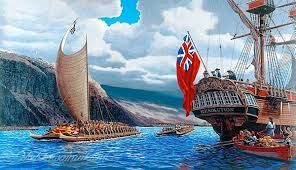
Cook’s arrival in the Hawaiian Islands coincided with the natives’ annual festival honoring their fertility god Lono. As the natives had not seen Europeans nor big ships in the past, they thought that Cook was their native deity and celebrated his arrival with feasts and gifts. Eventually, however, natives realized that Cook and his men weren’t immortal when one of his sailors died of a stroke. Cook’s crew also began stripping the land of its wealth and resources (like pineapples).
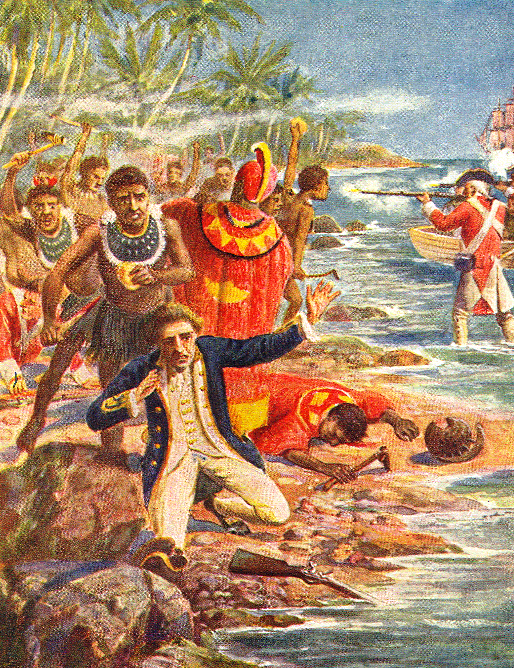
In February 1779, Cook discovered that the natives had stolen one of his cutter boats. Enraged, Cook ordered a landing party and instructed them to take King Kalani’ōpu’u hostage. Cook intended to ransom the King for the return of his cutter. The Hawaiians, however, swarmed to the king’s aid. As Cook and his men tried to escape, they were pelted with stones and clubbed viciously. At some point in the melee, Cook was stabbed in the back with a knife that he had gifted the natives as a token of peace.
Want to have the
Regimental Brewmeister
at your site or event?
You can hire me.
https://colonialbrewer.com/yes-you-can-hire-me-for-your-event-or-site/
 Michael Carver -- Historical Interpreter/Reenactor