
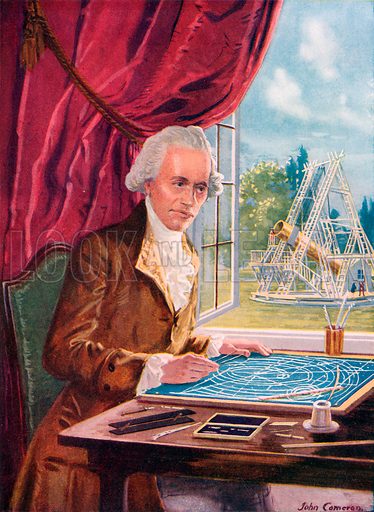
I know I am going to get a lot of sixth grade jibes for writing about what we call Uranus but here goes. Until 1781, the known solar system consisted of six planets (Mercury, Venus, Earth, Mars, Jupiter, and Saturn). These were all the planets that could be observed with the naked eye. The others were too far away, and hence too dim to be observed without a telescope.
On March 13 1781 William Herschel observed a faint object in the constellation Gemini and noted that it moved slowly relative to the background stars. First thinking it a comet, he trained his telescopes on the object and spotted a curious object in the sky, that he initially assumed was a star. A few days later he sighted it again, but found it had moved. He concluded from its movement that it was too close to Earth to be a star, and instead presumed it must be a comet. Further investigation confirmed that it wasn’t a comet at all, but a previously unknown planet.
Herschel wanted to name this new planet after the monarch of his adopted United Kingdom. As its discoverer, Herschel had naming rights and in honor of King George III, he called it Georgium sidus — Latin for George’s Star. Astronomers in other countries didn’t like the new planet named after the British monarch. Herschel’s proposed name was not popular outside of Britain and Hanover, and alternatives were soon proposed. Astronomer Jérôme Lalande proposed that it be named Herschel in honor of its discoverer. Swedish astronomer Erik Prosperin proposed the names Astraea, Cybele, and Neptune, which would become the name of the next planet to be discovered. The name was supported by other astronomers who liked the idea to commemorate the victories of the British Royal Naval fleet in the course of the American Revolutionary War by calling the new planet even Neptune George III or Neptune Great Britain. The name “Uranus” was first proposed by German astronomer Johann Elert Bode in order for it to be in conformity with the other planetary names – which are from classical mythology. This name did not achieve common use until 1850.
Want to have the
Regimental Brewmeister
at your site or event?
You can hire me.
https://colonialbrewer.com/yes-you-can-hire-me-for-your-event-or-site/
 Michael Carver -- Historical Interpreter/Reenactor