
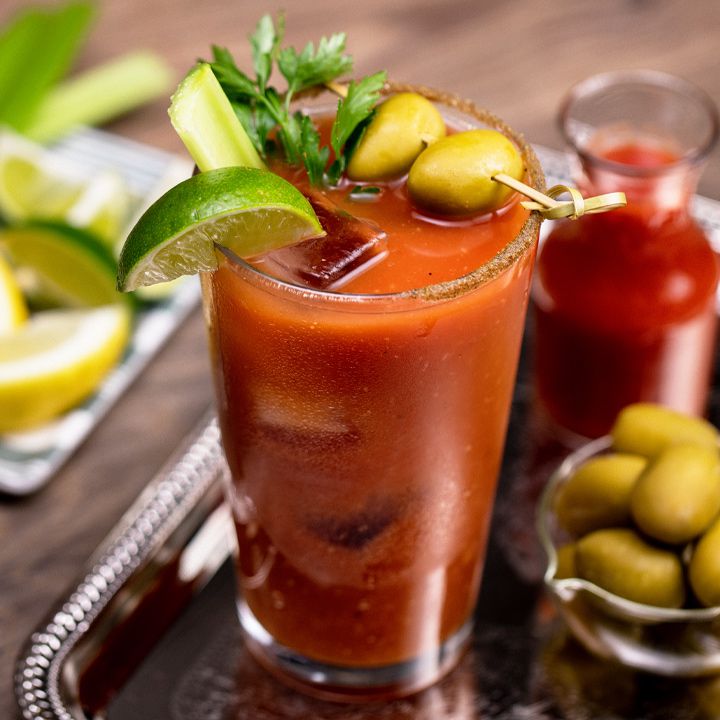
Perhaps it has something to do with the week I am spending in Texas or perhaps it is the fall-out from having watched The Serpent Queen on STARZ but my mind is stuck on “Bloody Mary.” I’m absolutely talking about the cocktail (I need 3 right now) but also the first Queen of England to rule in her own right — Mary I of England – also known only as “Bloody Mary.” She got this moniker as a result of her persecution of Protestants, who she burned at the stake by the hundreds. She was a bloodthirsty religious fanatic and during her five-year reign, Mary had over 300 religious dissenters burned at the stake in what are known as the Marian persecutions.
Being burned at the stake was the common punishment for heresy. This was because the Roman Catholic Church (like the lunatic State of Texas) considered anyone who did not share their religious views as having an infection that had to be erased so as not to poison society at large. The punishment for heresy was not only death but also the total destruction of the heretic’s corpse to prevent the use of their body parts for relics. This is why heretics were burned and their ashes thrown into the river. Mary’s choice of burning was completely standard practice for the period.
Her sister, Elizabeth I, practiced the same purges only she considered Catholics to be heretics. Elizabeth was a little more savvy: in her reign, those convicted of practicing Catholicism were convicted as traitors and punished accordingly, by being hanged, drawn, quartered and burned. The idea this was that while people could dispute religious belief, no one could ever possibly agree that treason was permissible.
Born on February 18, 1516, Mary was not the long-awaited son her parents, Henry VIII and Catherine of Aragon, but rather a daughter who could not inherit the throne on her own. This put Henry’s legacy in jeopardy. She survived infancy and grew up in the public eye as a beloved princess—at least until her teenage years, when her father’s infatuation with Anne Boleyn led him to divorce her mother and break with the Catholic Church. Declared illegitimate and separated from her mother, Mary refused to acknowledge the validity of her parents’ divorce or her father’s status as head of the Church of England. When her younger half-brother, Edward VI, was crowned king, he expanded Henry’s schism with Catholicism. When Edward died six years later, he attempted to subvert Henry VIII’s wishes by leaving the crown to Protestant cousin Lady Jane Grey, excluding those next in line—Mary and her younger half-sister, Elizabeth—from the succession. Mary chose to remain in England and fight for what was rightfully hers. She marched on London and declared herself queen and Elizabeth as a queen-in-waiting.
During her five-year reign, Mary wore the English Crown in her own right, rather than as the wife of a king. She prioritized religion above all else with a peculiar focus reversing the split initiated by her father ad restoring the Catholic Church dominance in England and this cemented her reputation as “Bloody Mary.”
And this brings us to not one but two great cocktails meant to remind us to be more religiously tolerant. The Bloody Mary and the Bloody Maria.
The “Bloody Mary” was first created in the 1920s at Harry’s New York Bar which was not in New York but rather in France. Harry’s opened in 1911 in New York but was later disassembled and shipped to Paris during Prohibition. In the 1920’s, people who escaped the Russian Revolution began arriving in Paris and they brought vodka with them which was new to France. Ferdinand “Pete” Petiot, the bartender at Harry’s, found this foreign spirit to be tasteless, but Petiot also discovered American canned tomato juice, which in the alcohol-free days of Prohibition was called a “tomato juice cocktail.” Petiot combined vodka with American canned tomato juice and seasoning, and the rest is history.
After Prohibition ended, Petiot returned to New York and took over the bar at the St. Regis Hotel in Manhattan. He brought his signature cocktail with him to New York City, giving it the name Red Snapper. Petiot reimagined the cocktail, adding in horseradish, Tabasco sauce, lemon juice, and celery salt to his base recipe. The new jazzed up version became an instant classic. This spicier cocktail was relabeled “Bloody Mary” after Mary Tudor and her bloody reign against Protestants. The tomato juice represents the blood shed during this time and the fiery vodka illustrates Queen Mary Tudor’s wicked means of executing her enemies.
Bloody Mary Recipe
- 1.5 oz vodka
- 3 oz T=tomato Juice
- 0.3 oz lime Juice
- 5 drops tobacco sauce
- Pinch of salt and pepper
- Celery stick as garnish
If you are like Pete Petiot and find vodka as a tasteless spirit, try tequila. The Bloody Marias with its non-traditional ingredients to make a complex, spicy, and even citrusy experience. While the Bloody Mary has been around since about the 1920s, but the Bloody Maria’s history is a bit murkier. The Bloody Maria was created in the 1930s in Mexico City. It was named after a famous Mexican actress, Maria Felix. Maria Felix was best known for the title role of Doña Bárbara (1943). She appeared in almost 50 movies made in Mexico, Spain, France, Italy and Argentina.
Bloody Maria Recipe
- 2 oz. tequila
- 1 tsp. horseradish
- 2 dashes Tabasco sauce
- 2 dashes Tapatio hot sauce
- 3 dashes Worcestershire sauce
- 1 dash lime juice
- salt to rim glass
- 1 pinch ground black pepper
- Garnish of choice
Want to have the
Regimental Brewmeister
at your site or event?
You can hire me.
https://colonialbrewer.com/yes-you-can-hire-me-for-your-event-or-site/
 Michael Carver -- Historical Interpreter/Reenactor