
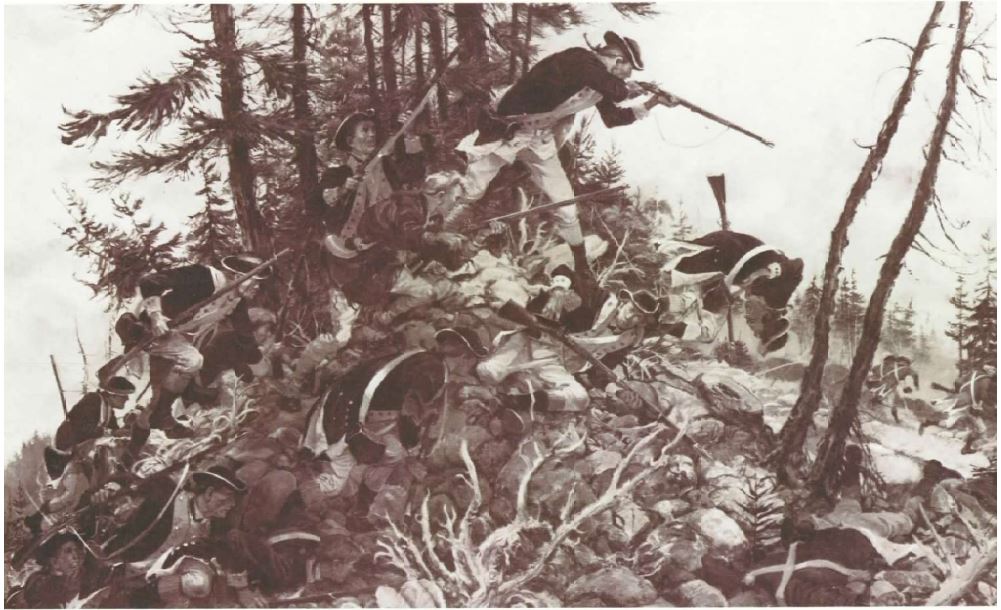
28 July 1779
In spring of 1779 the British commander-in-chief in North America, General Sir Henry Clinton, directed that a strong outpost be established on the tip of the Bagaduce Peninsula in Penobscot Bay, Maine. Brigadier General Francis McLean, military commander of Nova Scotia, led 700 troops of the 74th Foot (Argyle Highlanders) and 82d Foot (Hamilton Regiment) ashore in mid-June to begin work on what became Fort George . Word of the British intrusion into what was then Massachusetts territory soon spread southward. At Boston militia troops were quickly assembled under the command of Brigadier General Solomon Lovell. Captain Dudley Salronstall of the Continental frigate Warren brought together an impressive array of Continental, Massachusetts state, and privateer vessels. On board ships of the Continental and Massachusetts navies were slightly over 300 Marines commanded by the senior Marine officer of the fleet, Captain John Welsh of the Warren. On 19 July, less than a month after news of the British occupation, the American expedition cleared Boston harbor. Two days after their arrival in Penobscot Bay (28 July 1779) 200 Marines under Captain Welch and an equal number of militiamen scrambled out of ships boats and climbed the steep, heavily forested bluff guarding the peninsula’s western approaches, initiating a drive that was intended to rid the area of the red-uniformed British troops. The bold Marine-led assault was successful in gaining the bluff and securing a foothold on the peninsula, bur the expedition failed in its objective. After two weeks of skirmishes and abortive attacks, the American fleet was forced by the appearance of a large British relief squadron to retire up the Penobscot River. There the Americans burned their ships and retreated southward through the Maine wilderness. The landing at Bagaduce proved to be the last amphibious assault conducted by Marines until the War with Mexico in 1846.
 Michael Carver -- Historical Interpreter/Reenactor