
Like many early American customs, dueling was imported from England as a “civilized” means for gentlemen to settle irreconcilable differences. The practice was so ingrained in British culture that in 1777, a group of Irishmen codified dueling practices in a document called the Code Duello. The Code contained 26 specific rules outlining all aspects of the duel, from the time of day during which challenges could be received to the number of shots or wounds required for satisfaction of honor.
A duel is a very controlled sort of fight. In a duel, two opponents face each other on equal terms Unlike common brawls, duels happened after a cooling off period rather than immediately upon insult. One man would issue a challenge to another, who would often respond by directing further matters to his second. A second was a friend who came along to help prepare your weapons, make sure the other duelist wasn’t going to ambush you and make sure the rules of the duel were being followed. After a challenge issued, the seconds would arrange all the details. The whole process could take days as seconds were also supposed to try to defuse the situation that led to the duel by getting an apology from one party or another. The seconds’ primary duty was to try to reconcile the parties without violence. If the second could get the other party to apologize, the matter usually ended. It was only when the seconds could not intervene that the opponents would fight. The opponent who was challenged choses the weapons and the time and place of the encounter. Up until combat began, apologies could be given and the duel stopped. After combat began, it could be stopped only after honor had been satisfied.
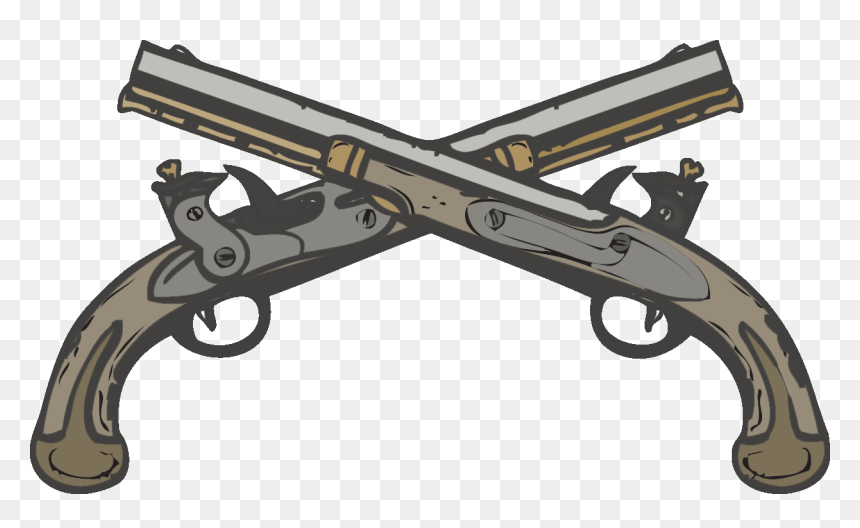
Most duelists chose pistols as their weapons because the chance of dying in a pistol duel was relatively slim. Flintlocks often misfired and even in the hands of an experienced shooter, accuracy was difficult.
When guns were used in duels, certain sets of rules indicated that only smooth-bore barrels were acceptable, as opposed to rifled barrels that cause the bullet to spin and give it greater accuracy and range (Holland, pg. 84). Many of the rules of dueling seem designed to prevent death and injury, or at least to reduce the likelihood thereof. For example, duelists were sometimes required to face away from each other, only turning to fire when the proper signal was given. This didn’t give them enough time to properly aim their weapons. The Code Duello demanded that pistols be discharged within three seconds; to take aim for a longer time period was considered dishonorable. Interestingly, the U.S. Navy included the text of the Code Duello in the midshipman’s handbook up until dueling by naval officers was finally banned in 1862.
Unlike most disagreements, when one is challenged to a duel a curt and disingenuous apology is not sufficient. The Code Duello dictates a complex method of deciding who should apologize first. The first offense requires the first apology, though the retort may have been more offensive than the insult. Example: A tells B he is impertinent, etc. B retorts that he lies; yet A must make the first apology because he gave the first offense, and then B may explain away the retort by a subsequent apology. The rules also dictate when an apology can be accepted, thus preventing the duel, and when no verbal apology will be sufficient. For example, a blow is strictly prohibited under any circumstances among gentlemen, no verbal apology can be received for such an insult. The alternatives, therefore — the offender handing a cane to the injured party, to be used on his own back, at the same time begging pardon.
A duel is not a brawl, as such, a certain level of etiquette and dignity was expected of all participants. For example, no shooting into the air is admissible in any case. The challenger ought not to have challenged without receiving offense; and the challenged ought, if he gave offense, to have made an apology before he came on the ground. Furthermore, challenges are never to be delivered at night, unless the party to be challenged intend leaving the place of offense before morning; for it is desirable to avoid all hot-headed proceedings.
Dueling “to the death” is, interestingly enough, considered dishonorable in the Code Duello. Dueling is about recovering honor, not about killing. Sword fights are to continue only until one is well blooded, disabled, or disarmed; or until, after receiving a wound, and blood being drawn, the aggressor begs pardon. Any wound sufficient to agitate the nerves and necessarily make the hand shake, must end the business for that day.
Dueling is very much entwined with honor. However, the concept of honor in centuries past is very different from what most people think of as honor today. For one thing, the socially accepted concept of honor had very little to do with being a “good” person. It was tied directly to nobility — if your family was rich and had the favor of the king, as well as a noble title of some kind (Duke, Prince, Earl, etc.), then you had honor.
If you were a gentleman or a member of the nobility, you had to constantly protect your honor against various challenges to it — and not just your own honor, but your entire family’s honor, for several generations forward and back. There were several ways to lose honor, but the most common and most important was to be considered a coward. Refusal to accept a challenge to a duel entitled your opponent to publish an account of your cowardice, report it in church or simply spread the word to all his friends.
Eventually, society began to frown upon the practice of dueling. Even so, it didn’t die out because of sudden opposition to the practice. Both George Washington and Benjamin Franklin found dueling a waste of human life and many states passed laws against dueling, but for many years juries refused to find anyone guilty of the crime. Ultimately, what killed dueling (pun intended) was the fact that literally anyone could engage in a duel. By the 19th Century, weapons were commonly available. It was no longer a providence of the rich and nobility, now the middle class and even the poor engaged in challenges and combat (hence the mythos of the Wild West gun fight). The ultimate demise of dueling was due to a complex set of cultural factors. It had survived for centuries as something carried out by noble men to help keep themselves distinct from the lower classes. Once dueling had spread to every stratum of society, it no longer served this function. At that point, the destructive nature of dueling began to have an impact on public opinion. The Civil War in the United States and World War I in Europe mark rough points at which dueling began to decline in the respective cultures.
Today, dueling still exists, but it has taken less bloody forms. Men engage in sports and gambling to settle scores. You even see it in video games. Interestingly, in the 1908 Olympics, pistol dueling was a sport. Staged duels (much like our reenactment events) were conducted using the Olympic fencing arena and in front of invited guests. The competition involved two competitors firing at each other with dueling pistols loaded with wax bullets and wearing protective equipment for the torso, face, and hands. Teams were sent by countries including France, the UK, and the USA. The 20-meter competition was won by the French team of Major Ferrus, J Marais and J Rouvcanachi.
You are all sworn to secrecy (hence my publishing plans on the internet 😊) but there is very likely to be a duel at Moland House on August 17. The Captain of the AWI Privateers is a contemptuous pompous ass and I am calling him out. I have not yet heard back from his second but I know he is no coward so this will likely be settled on a field of honor.
Want to have the
Regimental Brewmeister
at your site or event?
You can hire me.
https://colonialbrewer.com/yes-you-can-hire-me-for-your-event-or-site/
 Michael Carver -- Historical Interpreter/Reenactor