
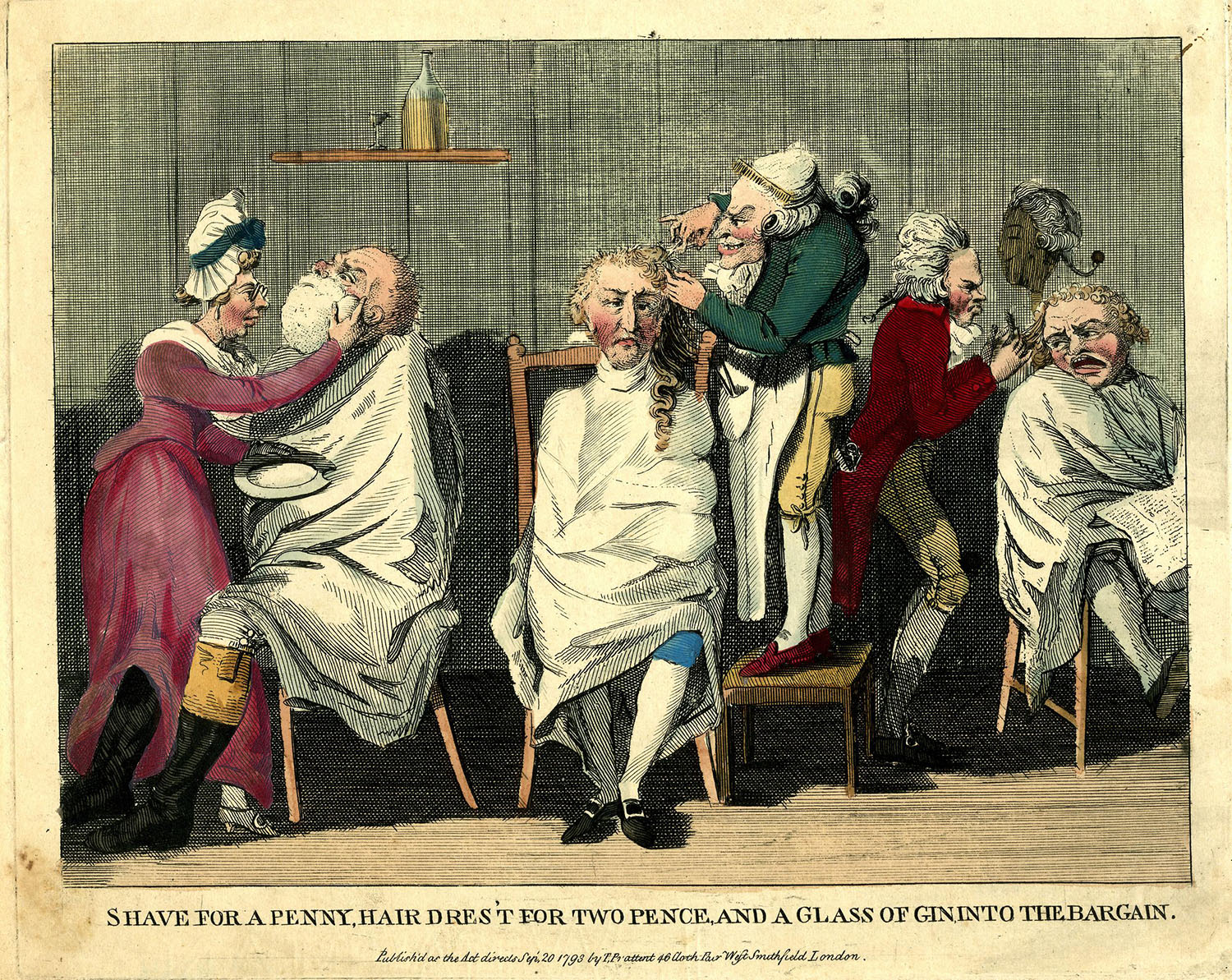
Men have facial hair and removing it can be either a pleasure of a torture depending upon your equipment, the geometry of your face, and your social, political, and religious proclivities. This has always been and will likely always be true, and yet there are many in the reenacting community who want to ridicule men with well-trimmed beards at events. Let’s be clear on the subject, white, Anglican protestant, upper-class Englishmen generally followed a fashion of being clean shaven in the 18th Century. So, if you are portraying one of the Founding Fathers or an officer in the British Army, a cleanly shaven chin is a must. BUT, as we become more nuanced in our depiction of 18th Century life and we include ALL THE OTHER PEOPLE who created our country, that image is not universal. Fashion is about personal identity and not everyone identified as a member of the English aristocracy. In fact, many came to this country specifically to distance themselves from the morays and prejudices of the church and English society. So, expecting everyone to look the same, outside of a military presentation, is wrong. Jews, Germans, Frenchmen, Spaniards, and Arabs all made up significant percentages of the populations of cities like Philadelphia and New York and these traditions did not embrace the clean-shaven fashions of the English.
More important than obvious diversity question, however, I think it is also important to understand WHY Englishmen choose to be clean-shaven. Blindly following the latest fashion is a sign of stupidity and these men were not stupid. So, why were men often clean-shaven in the late 18th Century? The 18th century was unusually hairless but what drove men to the barber?
Many of or self-appointed fashion police in the reenacting community rely on art and portraits to justify their notations of what people should look like. Its justifiable. After all, how else can you see what people in the 18th Century looked like? Consider, however, YOUR behavior when you go to have your portrait taken. These are occasions to look your best, wear your finest clothing, and present your best image. Daily attire and coiffure may be quite different. But we know shaving was critical in the army. As Commander in Chief of the Continental Army, George Washington imposed several regulations to control hygiene among his troops. He commanded the soldiers to present “as decent as his circumstances will permit—having his beard shaved—hair combed—face washed—and cloaths put on in the best manner in his power”[1]But it is important to understand not just that these orders were issued but why. Remember, germ-theory is poorly understood in the 18th Century as hence so was hygiene.[2] That said, the APPEARANCE of hygiene was critical to the Founding Fathers and this is why there is such a fascination with shaving.
Being impeccably dressed, having your wig well styled and your face shaven (or even made-up with cosmetics) substituted for actual personal cleanliness. Clean shirts, neckcloths, and stockings, worn under brushed and stain-free suits, went a long way to creating a favorable reception.
Shaving chimed in with Enlightenment notions of gentility, polish, and proper self-presentation. It was the caprice of fashion. Facial hair was seen as barbarous and hirsute wildness spoke of carelessness and debasement. It was also, quite literally, a justification for prejudices against peoples and cultures they considered inferior. So, forcing a clean-shaven appearance at reenactments is perpetuating 18th Century morals of racism, religious xenophobia, and cultural hatred.
Another reason shaving was so prominent in the images of our Founding Fathers is technology. In the mid-18th century, advances in steelmaking lead to tough and durable steels that could be polished to a mirror shine and a very sharp edge. The idea of shaving was not new but now it was practical for a man, often with the assistance of their manservant or a professional barber to present with a clean-shaven face. Only the wealthy, however, could afford their own razors and other shaving equipment. Most men relied on infrequent visits to the barber to trim their facial hair so having a perfectly clean-shaven face was a means of displaying wealth. Razors and soap were both expensive, the best imported from Europe. The less well-to-do could afford less frequent shaves and therefore often were seen with a three-to-seven-day beard.
After the Napoleonic Wars, new models of masculinity came into play, whiskers started to be seen as symbols of virility and male authority. Manliness was now hirsute and the trim elegance in the 18th-century manner was no longer the thing – for some but, again, not everyone.
So, next time you are at a reenactment and see a man with a beard, don’t judge, ask. Are they portraying someone other than the posh aristocracy? Are they portraying the diverse of those who really ran our communities, fought our wars, and built our country? Is their appearance befitting and as decent as his circumstances will permit or are they “loathsome in appearance”, always in need of bath and clean clothes? Chances are it’s not random. For example, the Regimental Brewmeister presents (at all times not just at events) as a Jew and it IS APPROPRIATE for me to sport neatly trimmed and coiffure facial hair.
[1] General Orders, 9 November 1777
[2] Some people, like Thomas Paine, actually thought that personal hygiene was unimportant as evidenced by Benjamin Franklin’s description of Paine’s Paris apartments — “I never sat down in such a filthy apartment in the whole course of my life. There was not a speck of cleanliness to be seen.” Another described Paine as “loathsome in appearance”, always in need of bath and clean clothes.
Want to have the
Regimental Brewmeister
at your site or event?
You can hire me.
https://colonialbrewer.com/yes-you-can-hire-me-for-your-event-or-site/
 Michael Carver -- Historical Interpreter/Reenactor