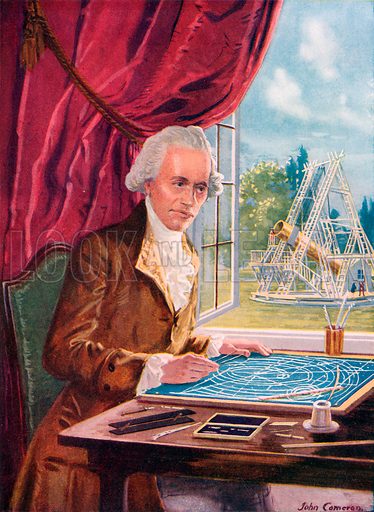
In 1799, David Rittenhouse presented outgoing US President, George Washington, with a new surveying set including one of his newly invented vernier compasses. This important instrument which enables a surveyor to compensate for the angular difference between true and magnetic north. The “Rittenhouse compass,” was constructed with a nonius or vernier scale so that the compass settings could be offset to agree with deviations in magnetic north, which is not constant. The meridian should be established by the motion of the heavenly bodies and made permanent by adjusting the ring that held the degree markings for the compass.
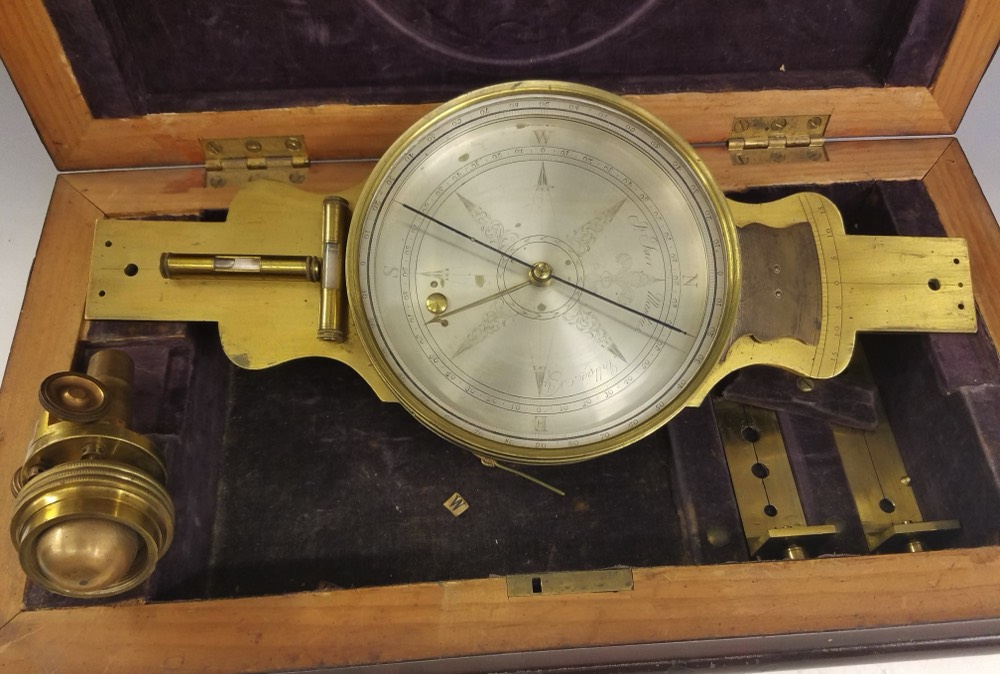
As a practical surveyor, David Rittenhouse was aware of the problems of magnetic variation and how it changed over time and place. He researched the differences in needle readings between various compasses for the same alignment of the sights. He also made at least one instrument designed for measuring the earth’s magnetic variation. This innovative instrument, which should probably be termed a variation compass, incorporates the mechanism of the vernier compass, perhaps without that result intended. One wonders if it was a precursor of the vernier compass.
One additional advantage the vernier compass had was that it reported fractional degrees in a manner that could be read by the human eye on a relatively small device. Many of you are old enough to remember working with vernier scales before digital tools became commonplace. These scales were commonly added to scientific instruments like calipers or weigh scales. Most of us were taught how to read them (ie you read the number where the lines, top and bottom, perfectly align) but never HOW these cool scales really work.
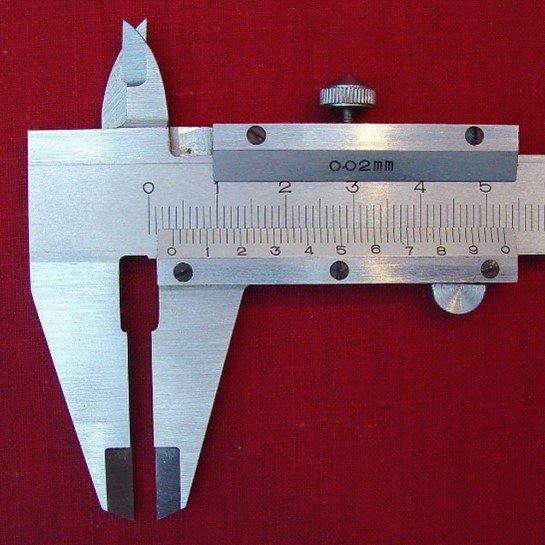
The frame has one set of markings (the main scale), usually graduated with divisions of size 1mm. There is another set of markings on the movable slide (the vernier scale) that lines up with the fixed scale. The vernier scale has finer divisions; in a standard basic vernier like in the picture above, 10 divisions of the vernier scale correspond to 9 divisions of the main scale. The vernier divisions are marked 0 through 9 and then 0 again. This means that the divisions on the vernier are separated by 0.9mm. This means that at any time, 9 of the 10 lines on the vernier scale do not align with markings on the main scale. As the scale advances 0.1 mm, that aligned mark will shift to the next line in the vernier scale allowing you to read the next decimal.
Its innovations like these that allowed 18th Century astronomers and surveyors to take measurements of astounding accuracy like the size of the Astronomical Unit (distance from the Sun to the Earth) that was determined in 1769 so closely that it could not be improved upon until 1969 and then only with the introduction of direct measurement using microwave reflections.
Want to learn more? Come to Hatfield, PA on April 26 (Battle of Crooked Billet) or May 31 (Living History Days) and learn about 18th Century surveying methods with a hands-on demonstration by “David Rittenhouse.”
Want to have the
Regimental Brewmeister
at your site or event?
You can hire me.
https://colonialbrewer.com/yes-you-can-hire-me-for-your-event-or-site/
 Michael Carver -- Historical Interpreter/Reenactor