
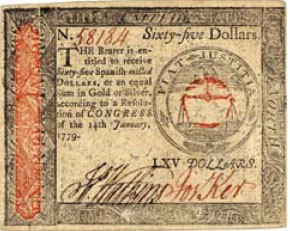
When Congress declared independence in 1776, they pitted an economically small country against one of the most powerful nations on the globe. Not only did these colonies need to form a new government, unify the people, and field an army to fight for independence, they also needed to find a way to pay for it all. Desperate for a source of money, Congress turned to printing paper promissory[i] notes.
Fortunately for the nascent Continental Army, fighting a guerrilla war thousands of miles form home was a daunting for the British army. While Britian’s army could easily make mincemeat out of whatever forces the Americans threw at them, supplying that super army was incredibly difficult and expensive. The British, having just come out of a global war with France, needed something more that pure military might to win the war. To bring the war to a conclusion, Britian turned to economic warfare.
A campaign was devised to undermine the nascent American economy. The hope was that if the economy was in shambles, Americans would not be able to purchase the men and material needed to continue the war. By undermining the economy, they would also be undermining the authority and credibility of the American Congress. Once people lost faith in the Congress, they would realize that war could not be won, and they would all return to the King. At first attempts to limit American trade with foreign nations using the all-powerful British Navy were undertaken. The navy interdicted as much overseas commerce as possible and began searching vessels from “neutral” countries for war materials in route to America. Then While these activities were effective to a point but failed to blunt the American resolve to continue the war.
Then the army initiated a massive counterfeiting ring, flooding the economy with Congressional paper currency to the point of making it almost worthless. This was intended to crash the American economy. No economy, no more war.
The majority of the counterfeiting was done out of New York City. In the 18th Century, we did not have the advanced security measures that are used today to dissuade counterfeiters. Even though bank notes had individual handwritten serial numbers and signatures, these were no deterrent as they were easily forged. In addition, most of the Continental currency that was printed by legitimate services was done on the cheap, with little eye to quality. This made the process of counterfeiting it much easier. Often the fake currency could be easily spotted because it was of higher quality than the legitimate bills.
Once printed, the bills had to be into circulation. One method involved finding men who had deserted the Patriot cause and fled to British lines, lining their pockets with the fake cash, and convincing them to cross back over and spend what they could. The practice was risky. A soldier named David Gambell of the 8th Pennsylvania Regiment, for example, had deserted and upon being captured was found with counterfeit money in his possession. He was court-martialed and sentenced to death by order of General Washington. Another method of dissemination was less subtle. Often in the New York newspapers were advertisements looking for people travelling into the colonies who would be willing to “wallpaper” with Continental bills. In the April 14, 1777 edition of the New York Gazette an ad appeared that specifically requested people to take into the other colonies “any number of counterfeit notes.” The advertisement came to the attention of General Washington who on April 18 sent a copy to Congress, writing that the scheme “shows that no artifices are left untried by the enemy to injure us.”
It was not just civilians of questionable loyalty that were tasked with spreading the fake currency. British soldiers who became prisoners of war were on occasion charged with using counterfeit Continental money to purchase supplies, most notably after the capture of General Burgoyne’s army in 1777. According to the surrender terms the British were to be allowed to return to Europe. Congress, however, refused to allow their return, claiming several instances of British violations of the surrender terms. Among congressional complaints was the “spending habits” of the British prisoners when purchasing supplies from the locals. When General Howe was informed of the issues he denied the use of counterfeit currency it in a letter to General Washington, calling the accusation that the men were knowingly spreading fake currency “too illiberal to deserve a serious answer.”
The counterfeiting of Continental Currency had a devastating effect on the young nation’s economy. As the war progressed the value of the dollar fell dramatically for several reasons. One was the lack of any sort of backing to bolster its value. Paper money is basically a promise that it is worth what it says it is. Without massive gold and silver reserves backing it up the dollar was subject to fluctuation that was based on the strength of the promise, and that promise was tied to the fortunes of the army. When the army had success the value of the dollar rose, but with every failure it plummeted. The American Army lost far more battles that it won which ultimately made it hard to purchase supplies and necessities that the army needed to win. The circle was a vicious one.
These highly devalued dollars meant that the large numbers of people in the colonies were simply not be willing to sell supplies to Congress or the army for paper money. This often led to the army having to “requisition” supplies leaving the people with at best useless stacks of paper money and at worst written receipts that could be turned in for reimbursement, someday. On the hand, the British army could usually go to the same people and offer specie (gold or silver), quickly becoming the preferred people to sell to. Faced with supporting their sense of liberty or feeding their families, many farmers chose the safe trade with the British.
All this counterfeiting led to Congress passing a law that made counterfeiting a CAPITAL CRIME. Under English Law the act was already considered treason and punishable by death and while most colonies had some sort of law on the books regarding counterfeiting, they mainly dealt with British money specifically. Congress wanted to ensure that anyone caught and convicted of making or passing the fake Continental currency would be sentenced to death. In 1780 Congress even took the extraordinary step of offering a bounty on counterfeiters, “two thousand dollars in the present Continental currency to any person or persons who take and prosecute to conviction.” This reward was worth about ten dollars specie at the time.
By 1780, the amount of counterfeit currency in circulation may have exceed the amount of legitimate currency, the economy hung on but never fully collapsed. Congress continued to shore up the system by instituting price and wage controls as well as securing loans from European powers. The Treaty of Alliance with France in 1778 went a long way to bolstering the confidence the people had in the Congress and the army, which helped prevent a war-ending panic but as the value dropped, Congress had no choice but to print more money, driving the value down even further. By 1781, the exchange rate was $225 paper currency to $1 specie. This was at a time when the average Continental army private made $5 a month in Continental scrip, if he was paid at all.
[i] The original currencies of the colonies and eventually the states were issues with the promise that they could be redeemed for gold or silver specie. This Gold Standard (and later Silver Standard) would be the backbone of the US Dollar until 1987.
Want to have the
Regimental Brewmeister
at your site or event?
You can hire me.
https://colonialbrewer.com/yes-you-can-hire-me-for-your-event-or-site/
 Michael Carver -- Historical Interpreter/Reenactor