
We often go to Independence National Historical Park just to see the big historic sites but its good to remember that this is also a very tranquil park (when you get away from the tourist). Next time you are there, take some time to visit the gardens.
18th Century Garden
The 18th Century Garden showcases plants that were frequently grown in Philadelphia during the 1700s. Defined by its lovely gazebo and geometric patterns, the 18th Century Garden recalls the formal landscape designs that were en vogue during early 1770’s.
Lady Bird Johnson, wife of President Lyndon B. Johnson, dedicated the 18th Century Garden to the Founding Fathers in 1966.
Rose Garden
The Rose Garden in the center of a landscaped area bounded by Locust and Walnut Street and 4th and 5th Streets. At the garden entrance, there is cobblestone paving which was in 1796 the courtyard of a stable The Rose Garden has 96 varieties of antique roses. Among these are the “Old Bush” rose (Chines Monthly Perpetual) and the green flowered rose (Rosa chinensis viridiflora). Unlike the modern hybrid roses, the majority of these roses flower only once a year (June).
The Rose Garden was donated by the Daughters of the American Revolution in honor of the Signers of the Declaration of Independence, and dedicated in May 1971.
Magnolia Garden
Inspired by George Washington’s interest in magnolia trees, the Magnolia Garden has thirteen magnolia trees lining its perimeter. Each tree represents one of the 13 original colonies. The charming garden bursts with delicate pink hues in early spring, among which are Saucer Magnolias, Narcissus Snow Azaleas, English Oaks, Honey Locusts, Cotoneasters, and a ground cover of English Ivy.
The Magnolia Garden was created by the Garden Club of America and donated to the park in 1959.
Benjamin Rush Garden
The former site of Dr. Benjamin Rush’s house is now a garden and home of the Bicentennial Bell which was a gift to the United States from Great Britian in 1976. Located on the corner of Third and Walnut Streets, the garden’s symmetry echoes the features that were popular in 18th-century gardens with symmetrical planting beds bordered by low boxwood hedges surrounded by low brick walls. The Benjamin Rush Garden focuses on the types of flowers and plants that played a role in the scientific network of the 1700s. It was common for men of letter such as Benjamin Franklin, Benjamin Rush, and William Bartram to exchange seeds with their counterparts in England in the pursuit of knowledge.
Washington Square
Washington Square is one of the original five parks within William Penn’s “Greene Countrie Towne.” Originally known as Southeast Square, in the 18th century, it had become a burial ground for poor Philadelphians, American and British soldiers during the British occupation of Philadelphia (1777-78), and victims of yellow fever. The square served the living as well; enslaved and free African Americans socialized here, and the city later landscaped the grounds as a public park. In 1825, the square was renamed in honor of George Washington.
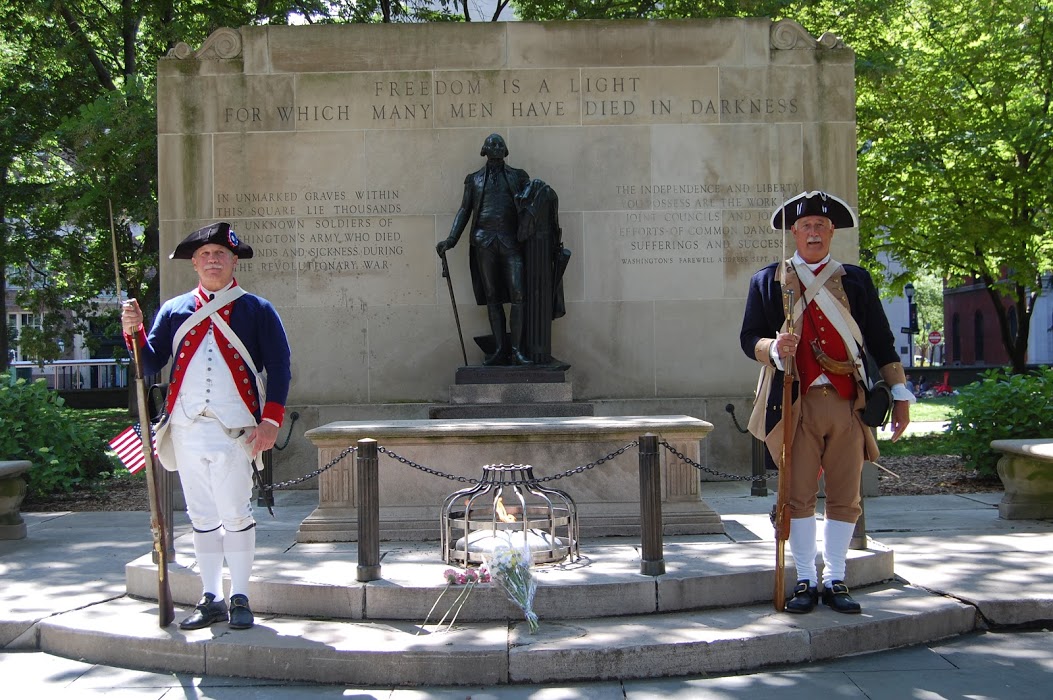
Located within the park is the Tomb of the Unknown Soldier of the American Revolution. This memorial, erected in 1954, contains the remains of an unknown Revolutionary War soldier who perished in the fight for independence. An eternal flame honors the high price paid by soldiers in the name of freedom.
Want to have the
Regimental Brewmeister
at your site or event?
You can hire me.
https://colonialbrewer.com/yes-you-can-hire-me-for-your-event-or-site/
 Michael Carver -- Historical Interpreter/Reenactor