
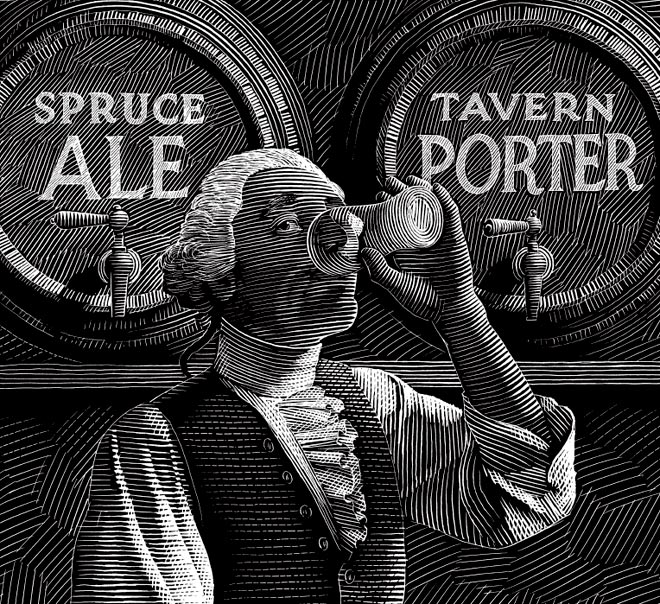
Many aficionados of Jane Austen will tell you about Spruce Beer in England but spruce trees are not native to Britain, and spruce beer, cannot be produced locally. Spruce beer in only exists as an imported product.
There are several distinct traditions of spruce beer. The ‘North American tradition’ of Spruce Beer (which I brew) has its roots in the tribal traditions of the Hurons. When Jacques Cartier overwintered in Quebec in 1535-36, almost all his men fell ill with scurvy. Huron Indian women showed them how to make tea and poultices from the bark of a local tree, which quickly
returned them to health. That tree was probably White Cedar, thuja occidentalis, rather than spruce. Later French settlers turned to spruce trees and brewed ‘la bière très bonne pour le Pruche’ (very good beer from spruce trees).
By the early 1800’s, spruce beer is being made from the essence of spruce obtained ‘by evaporating boiled black spruce to a syrup” then brewing that essence with molasses or maple syrup (no malt or hops). This was a very significant beer for the Royal Navy as spruce sap is loaded with ascorbic acid, Vitamin C, and drinkers of spruce beer avoided scurvy, the disease caused by lack of Vitamin C, and the curse of long-distance voyagers who lacked access to fresh foods. The Admiralty experimented with spruce extracts for long distant voyages. In 1777, Lt James Cook and his men brewed spruce beer in New Zealand on his third and last voyage to and at Nootka Sound on the Canadian west coast, where enough beer was brewed ‘to last the ship’s company for two or three months. Cook recorded that his crews were free of scurvy and he attributed this to spruce beer, which was drunk every other day.
While the Navy was drinking spruce beer brewed exclusively with spruce extracts and sugars like molasses, the British Army in North America learned the value of spruce beer from the French. John Knox who served in North America between 1757 and 1760 with the 43rd
Regiment of Foot, said the troops occupying Louisbourg after its capture were supplied with
spruce beer. “This this liquor was necessary for the preservation of the health of our men.” Following this success, the Earl of Loudoun, insisted on an allowance of two quarts of spruce beer per man each day. General Jeffery Amherst later increased this ration to five pints per day. By the end of the war (Seven Years War) the British Army required that each regiment assign one man duty of brewing, and instructions brew spruce beer.
In the 1820’s American-style spruce beer began to lose its popularity in Britain, perhaps because the Royal Navy was now using lime juice as its main defense against scurvy. There is, however, an older Danzig or Black Beer tradition. This beer was introduced in England during the reign of Henry VII and comes from North Germany. The name ‘spruce beer’ came from the German ‘Sprossen-bier’, literally ‘sprouts beer’, since it was flavored with the new sprouts of Norway spruce, Picea abies, or silver fir, Abies alba. ‘Sprossen’ was mistranslated by English-speakers as ‘Spruce.’ This beer was made by boiling wort for up to ten hours until it reached a gravity a stupefying 1200 to 1260 OG. The wort was then run into wooden vessels and fermentation undertaken by a ‘mixed microflora’ of yeasts present in the wood to produce a final beer with more than 7% alcohol and an acidity (as lactic acid) of 1 to 2%. The resulting beer is dark brown and extremely rich and very sweet. It is not possible to drink much ‘Sprossen-bier’ as it is heavy and very full-bodied. Most frequently, this beer is mixed with other beer or diluted. The high gravity makes it easy to export and this is how it comes to England.
Spruce Black beer continued to be imported from Danzig to Great Britain for its supposed health-giving properties. This was considered a cure for cold (two tablespoonsful of Dantzic black beer, taken with hot water, sugar, and about half-a-glass of rum, or malt whisky; immediately before going to bed). By the 20th century black beer manufacturers in Britain were concentrating almost exclusively on the healthy aspects of the drink – “No house should be without a bottle of this wholesome and beneficial beer. For growing children, it has no equal….”
So, whichever version of Spruce Beer you find to be the most wholesome, it is clearly good for you. Enjoy!
Want to have the
Regimental Brewmeister
at your site or event?
You can hire me.
https://colonialbrewer.com/yes-you-can-hire-me-for-your-event-or-site/
 Michael Carver -- Historical Interpreter/Reenactor