
The most enduring picture of Englishmen coming ashore in North America is the settlers of the Plymouth Colony. They did not come ashore where they had intended (Virginia) and they were not prepared for landfall in the harsh New England climate. Their choice of landfall was not by choice, but based upon the Mayflower’s dwindling beer supply and this drove their first industrial enterprise – beer production. Beer was considered a critical priority for the survival of their settlement so with lean resources they erected a brew-house as the second public building in the colony.
In Europe, it was well known that drinking water could make you deathly ill. They did not know why but the evidence was clear. Certain drinks – water, milk, and even some fruit juices – led to diseases of the gut. Ale drinkers were somehow spared this affliction so most people soon drank ale rather than risk water. Today, we know that it’s the boiling that rids beer of its pathogens, but this won’t be proven with any certainty until 1861[i]. Even though the new world had a seemingly inexhaustible supply of pristine water, few if any would ever dream of drinking it. So it was that a brew-house was an indispensable priority in each new settlement.
While the first inhabitants of Jamestown, neglected to include a person skilled in brewing in their initial settlement[ii], later settlers were careful to include brewers in their company. Ale and beer was a major dietary staple in the colonies. Literally everyone drank beer from cradle to grave. Infants were fed beer and it was especially recommended for nursing mothers. Farmers, laborers, merchants, lawyers, and craftsman all drank beer. It was not uncommon for drinking to begin even before breakfast and it continued with every meal throughout the day. So pervasive was the custom of drinking beer that employers were expected to provide their employees with beer to drink at work. It was both the nourishment and refreshment common throughout that period’s long work days.
While most of the brewing was done by women in the home, commercial breweries and taverns were plentiful by the early days of the 18th Century. Being a colony within a Mercantile economy[iii], brewers relied on supplies, especially hops, imported from England. The Dutch, however, found wild hops growing in New Amsterdam (AKA New York) and soon American 6 row barley and even corn was cultivated to make domestic beer. Of course, this, along with smuggled molasses and other products would become a source of friction with England after the Seven Years War as Parliament sought ways to pay its debts.
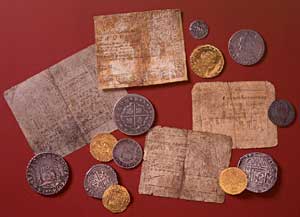
The main driver for adopting domestic supplies, however, was not an effort to be independent. There was a huge shortage of hard currency with which to pay for trade in in the colonies and essentially no stable monetary system. This lack of money stifled not just commercial production of beer, it retarded most economic development and forced a barter economy on most colonist.
The barter system with regard to beer production worked like this: Farmers would grow barley. This was a sustainable industry as they grew both the product and the seeds needed for the next years crops. The only real investment needed was, of course, the land but offers of land were the primary means of getting settlers to brave a transatlantic voyage to the new world. Once the farmer harvested his crop, they needed to convert it into a sellable commodity like flour, so they employed a miller. Unfortunately, these farmers rarely had money to pay for the services of the miller so the miller ground the barley (or wheat, corn, or other grains) in exchange for a percentage of the harvest. This leave the miller with a surplus of grains which they sell to a malter. The malter converts the grains into a commodity that can be used to brew beer or ferment whiskey — malt[iv]. This malt can either be sold to local brewers or be exported for hard currency. Finally, malt can be brewed into beer which can be sold locally or exported, again for hard currency.
To understand how value is created in this scheme, its useful to understand the prices each of these commodities would command in 1770. Barley sold for about 3 pence[v]/bushel. When milled into flour, this barley creates flour worth about 6 pence, so converting it to flour was very profitable for the farmer and the miller. That same barley, however, when converted to malt (at a cost of 6-7 pence/bushel) will command nearly 2 shillings. Brewing it into beer, however, yields 2 barrels of tavern ale (6%ABV) which will command over 3 pounds which even when all the costs of materials, labor, and taxes are rolled up yields a 98% profit margin (see chart below). So, this cycle benefits everyone in the supply chain – and it makes beer 😊.

Of course, this is only one aspect of the economic impact of the brewing industry in North America. In order to promote trade and “amenity” between the various colonies (similar concerns happened in all regions of the British Empire), taverns were created every 7-15 miles along major roadways, in ports, and at ferries. Each of the Royal Governors, as well as Parliament and the various colonial legislatures were concerned over the lack of economic activity and development in America’s interior lands. The Crown was keen to ensure that merchants did not limiting trade to the coastal regions but also developed opportunities to exploit the interior regions of the empire. Something was needed which would encourage travel and trade to undeveloped, rural sections.
Centuries earlier trade in England accelerated when it became easier for merchants to travel, meet others, and conduct business in comfortable surroundings. It wasn’t better roads and canals that drove this growth but rather the venerated English tavern. Taverns provided a convenient place to stay when traveling and served as a focal point of trade. Taverns became centers of commerce and the “Public House” also provided a gathering place for civic organizations like the postal system, the courts, election polls, and the militia. Representatives of the Crown directed that each community open a tavern or inn to tend the needs of travelers. As taverns were built and licensed (ie taxed) trade increased. Farmers could trade produce for a supply of ale. Trappers and hunters could bring their goods to markets that sprang up near taverns and sell or trade their goods. Eventually, other craftsmen moved into these areas and the economy of the entire colony expanded. The plan was simple to implement, quick to show a return and required virtually no investment from the King or Parliament. This system not only grew the economy but expanded the government’s ability to rule these back countries, increasing the overall worth of the American colonies in the eyes of the Crown. The role of the tavern as both a legal and commercial center had massive impact on colonial development. Almost all public life in many communities could be tied to the tavern and it was not long until it was also the social focus as well. Travelers invariably brought news and through this system the settlers maintained contact with each other and the mother country. Taverns also increased the demand for commercially brewed beer.
So as you can see, beer was at the forefront of social and economic development in the American Colonies. It drove significant economic activity in and of itself and it promoted other trade. It should come as no surprise that these same forces also fed the revolution. Protests in New England were often planned and launched from taverns. The Sons of Liberty frequently met in Boston’s Green Dragon. The Militia at Concord was stationed out of the Wright Tavern. The Continental Congress often used the City Tavern as their unofficial meeting house. And all these meeting were accompanied by beer.
[i] In 1861, Louis Pasteur proved sterilized broth in a closed flask stayed sterile, whilst sterilized broth in an open flask bred germs. Until Pasteur published his Germ Theory, it was thought that microbes spontaneously generated from organic material.
[ii] Their plight caused them to seek relief from England and they placed advertisements seeking “two brewers’ to join them.
[iii] Mercantilism is an economic practice by which governments used their economies to augment state power at the expense of other countries. Under mercantilism, nations seek to maximize the exports and minimize the imports, thus accumulating wealth in the form of bullion (mostly gold and silver).
[iv] Malt is barley that has been allowed to germinate thus releasing the enzymes and other metabolic processes needed to convert the starches in the grain into sugars that can be fermented. Once germinated, malt is then roasted, arresting the germination process so that the malt can be stored.
[v] One pound was made up of 240 pence, with 12 pence to the shilling and 20 shillings to the pound. A pound in 1770 is the equivalent of $2200 in modern US dollars.
Want to have the
Regimental Brewmeister
at your site or event?
You can hire me.
https://colonialbrewer.com/yes-you-can-hire-me-for-your-event-or-site/
 Michael Carver -- Historical Interpreter/Reenactor