
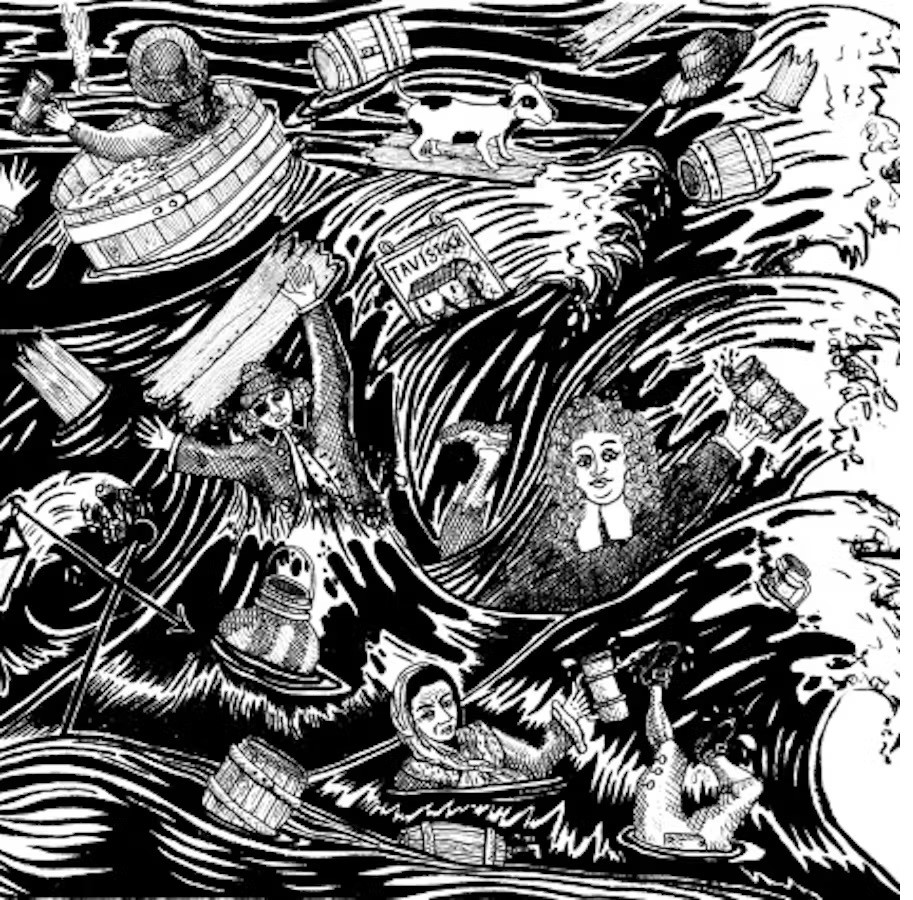
In 1814 the Meux Brewery of London experienced the catastrophic failure of a 120,000 gallon beer aging tank. The tank released almost all the beer instantly and the surge burst the walls of the brewhouse. Spilling into the street the flood killed 8 people “..by drowning, poisoning, by fumes and drunkenness.” As beer flowed down the street countless inhabitants dove into the flowing gutters for free beer.
The Horse Shoe Brewery stood at the corner of Great Russell Street and Tottenham Court Road. In 1810 the brewery installed a 22-foot-high wooden fermentation tank. The tank was held together with massive iron rings, and the huge vat held the equivalent of over 3,500 barrels of brown porter ale. Four years later, one of the iron rings around the tank snapped. The whole tank ruptured, and hot fermenting ale was released with such force that the brewery’s back wall collapsed. The force also blasted open several more vats, adding their contents to the flood that was bursting onto the street. More than 320,000 gallons of beer were released into the area of St Giles Rookery – a densely populated London slum.
The flood reached George Street and New Street within minutes, swamping them with a tide of beer. The 15-foot high wave of beer and debris inundated the basements of two houses, causing them to collapse. In one of the houses, Mary Banfield and her daughter Hannah were taking tea when the flood hit; both were killed. In the basement of the other house, an Irish wake was being held for a two year old boy who had died the previous day. The four mourners were all killed. The wave also took out the wall of the Tavistock Arms pub, trapping the teenage barmaid Eleanor Cooper in the rubble. In all, eight people were killed. Three brewery workers were rescued from the waist-high flood and another was pulled alive from the rubble.
All this ‘free’ beer led to hundreds of people scooping up the liquid in whatever containers they could. Some resorted to just drinking it, leading to reports of the death of a ninth victim some days later from alcohol poisoning. Some relatives exhibited the corpses of the victims for money. In one house, the macabre exhibition resulted in the collapse of the floor under the weight of all the visitors, plunging everyone waist-high into a beer-flooded cellar.
The brewery was taken to court over the accident but the disaster was ruled to be an Act of God, leaving no one responsible. This unique disaster was responsible for the gradual phasing out of wooden fermentation casks to be replaced by lined concrete vats. The Horse Shoe Brewery was demolished in 1922; the Dominion Theatre now sits partly on its site.
Want to have the
Regimental Brewmeister
at your site or event?
You can hire me.
https://colonialbrewer.com/yes-you-can-hire-me-for-your-event-or-site/
 Michael Carver -- Historical Interpreter/Reenactor