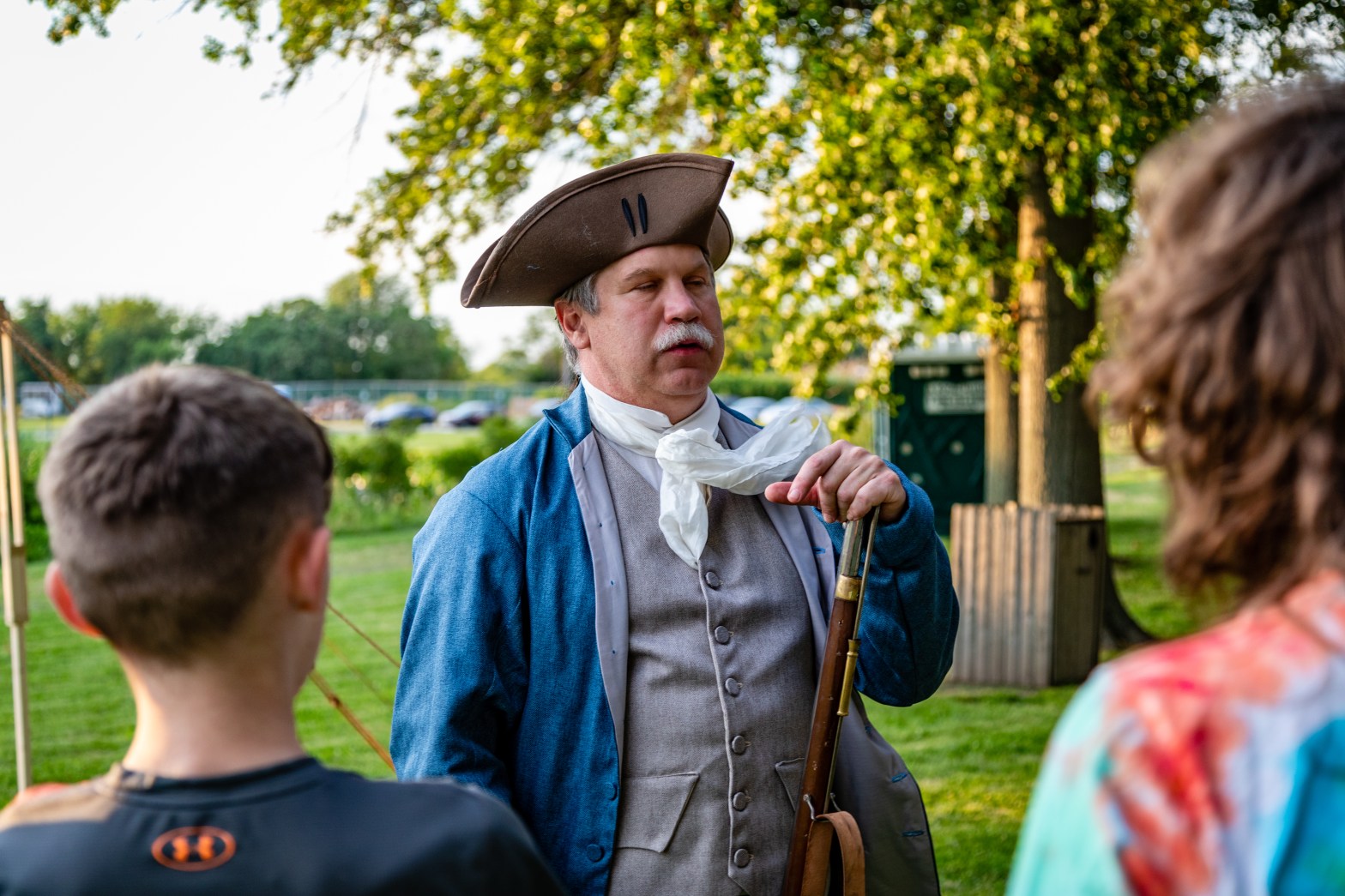
Add excitement and authentic color to an event, or create more traffic to your site, with Philadelphia’s best Colonial Brewer and tradesman. Whether it is a reenactment, motion picture, a tavern night for a private event, or other endeavor, I can bring can bring a real sense of authenticity and fun to your event and make it an occasion that people will long remember. Every large gathering of people in the 18th Century needed a brewer. I not only provided the libations that as Doctor Franklin so clearly stated “is proof that God loves us and wants us to be happy,” but I also make sure the that people remained healthy and free of waterborne disease.
Philadelphia is also a great center of science and technical learning in the 18th Century. Perhaps your group would like to meet Joseph Priestly first hand and learn how he discovered the element Oxygen. Perhaps your group wants to learn the fascinating story of how in 1769, we actually measured the size of the solar system. You may want to see an 18th Century surveying crew in action or observe a brewery or distillery. I bring all of these to real tangible life. In my presentations, participants are encouraged not just to watch but to take part in the using the tools and working through the problems and, of course, drinking the beer.
I have conduct presentations and tours for the National Park Service, Carpenters Hall, Pottsgrove Manor, Hope Lodge, Graeme Park, and with the 2nd PA/43rd Regiment of Foot and several other Philadelphia region historic sites for several years. I routinely speak to large audiences and my presentation is tight, interactive, dynamic, and engaging. I am eager to expand my repartee to additional skills so are looking to develop something new, I am also interested in working on those sorts of project. My rates are very reasonable and I give substantial discounts to non-profit historical sites. Let’s turn back the pages of history in an extraordinary way!
Colonial Brewer
Long before the American Revolutionary War, the British Army in North America learned from the French the importance of spruce beer for treating and preventing scurvy and keeping their soldiers “fit for service.” John Knox, an officer in the 43rd Regiment of Foot, insisted that his troops at Louisburg (1745) be supplied with spruce beer, “this liquor being thought necessary for the preservation of the health of our men.” Like brewers of the era, I do all my work without instrumentation, relying upon my basic senses of sight, smell, hearing, taste, and touch to do the work modern brewers have instrumentation like clocks, scales, hydrometers, and thermometers for. My aim is to recreate the methods, brews, and experience of a brewer from 1778 while telling stories of the American Revolution.
I also run hands on, immersive classes in 18th Century brewing where participants use my gear to brew their own beer using 18th Century materials and methods.

Admiral of the Blue Apron
Outside the church, the tavern was the most important institution in most towns. Taverns were used as meeting places for political assemblies (like the militia or the courts). People relied on taverns as the primary means of spreading news and ideas. Newspapers and stories were often shared by travelers in taverns. As conflicts erupted between the Crown and her colonies in the 1760’s, it was in the taverns that men discussed their responses and ultimate aims. It was in the colonial tavern that the revolutionary spirit launched our nation. Without taverns, it is likely that the various colonies would have remained separate and subjugated to the greater British Empire.
Patrons are invited to an evening of storytelling and merriment during which they can enjoy and 18th Century tavern experience complete with period beer, cocktails, competitive toasts, various entertainments, and maybe even a rousting political debate.

Colonial Surveyor
I present as a first-person impression of David Rittenhouse the noted astronomer, clockmaker, and founder of the US Mint. David began working as a surveyor when asked by William Penn in 1763-64 to settle a boundary dispute with Lord Baltimore. Rittenhouse first laid the twelve-mile radius around Newcastle, Delaware (then a part of Pennsylvania) which forms the modern boundary between Pennsylvania and Delaware. Rittenhouse’s work was so precise and well documented that it was incorporated without modification into the later survey by Charles Mason and Jeremiah Dixon (England’s most admired surveyors) of the Pennsylvania-Maryland border. Later Rittenhouse would help establish the boundaries of several other states and commonwealths both before and after Independence, including the boundaries between New Jersey, New York, and Pennsylvania. While Mason and Dixon began a survey of the Pennsylvania-Maryland border in 1763, that survey was interrupted in 1767. In 1784 Rittenhouse and Andrew Ellicott completed this survey of the Mason-Dixon line to the southwest corner of Pennsylvania with such precision that over the course of this 196-mile border the line varies only ½ inch from the 43rd latitude line. This will be an interactive program where participants are encouraged to employ the tools and techniques of the 18th Century Surveyor and actively measure and map a parcel of land. Participants will be taught to site lines using the compass and range poles. They will then measure those lines using the Gunter’s chain as well as measure splines off those lines for irregular boundaries. Finally, participants will be encouraged to use these measurements to draw maps and write property descriptions (which they may take away).

Colonial Scientist
While we all know the ramification of Enlightenment thinking on politics in the 18th Century, it also had a profound and seminal effect on science. Prior to the Enlightenment, scientific thought, when it could be separated from theology, was dominated by theories of absolute truth but over the course of the 16th and 17th Centuries this absolutism began to be replaced by modern empirical observation and experimentation. The world doesn’t work as it does because it should, or because of supernatural forces, but rather it follows series of natural laws. Rocks don’t fall to the earth because, as Plato argued, they belong to the earth; they fall because, as Newton observed, objects are attracted to each other in proportion to their mass and inverse proportion to their distance separation [squared]. God, if involved at all in the process at all, is the author of laws that govern the universe, not the prime mover who physically controls each particle. This subtle shift in focus and explosion of scientific inquiry and the creation of the “gentleman scientist.” My impression is to be an exemplar of the “Gentleman Scientist” – often as a first-person interpretation of “David Rittehhouse.” As a scientist, I am one who corresponds widely with others who are exploiting this new “scientific method” to challenge to challenge the status quo on EVERYTHING from physics to politics, one who conducts a wide variety of scientific investigations, and one who focuses on shifting our understanding of how the world works from folklore and tradition to mathematical scientific “laws.”

Colonial Spymaster
Going into the Revolution, Americans were at a huge disadvantage to the European powers when it came to cryptography, many of which had been using secret offices where sensitive letters were opened and deciphered by public officials for centuries. It was not uncommon for the messages of Revolutionary leaders and American diplomats to be intercepted and read by their enemies, both at home and abroad. To combat this, many of our founding fathers and key generals relied heavily on the use of cryptography. Cryptography is split into two ways of changing the message systematically to confuse anyone who intercepts it: these are codes and ciphers. Many people believe, and use, the word code to mean the same thing as cipher, but technically they are different.
Cryptography was no parlor game for the idle classes, but a serious business for revolutionary era statesmen who, like today’s politicians and spies, needed to conduct their business using secure messaging. Codes and ciphers involved rearranged letters, number substitutions, and other methods. What follows are some of the most common cyphers used by George Washington and the Continental Army.
This is an interactive program. As the Spy Master (dressed in Military attire) I will recruit and train spies and provide them with hands on exercises to practice their spy craft before being sent into the British encampments to collect intelligence. We will present several codes and cyphers for the participants to encode and decode messages, “dead drop” will be established in the environs of Carpenters Hall for our spies to exchange messages with other spies, and we will have discussions of famous spies in the George Washington’s and General Howe’s employ.
Espionage was critical to the war effort for both the British and American armies. This program is envisioned to give participants an opportunity to consider the risks these spies undertook and the hardships they encountered in providing information to their respective generals. I also want to add some clarity on the dilemma faced by Benedict Arnold as he considered his loyalties.

Special Talks and Presentations
The Regimental Brewmeister is happy to give talks and lectures at your site to audiences of any size. I typically come in 18th Century attire and conduct interactive discussions.
While I am happy to consider talks on other subjects, I have delivered very successful presentations on the following:
- Brewing for the Army – Washington’s General Orders stipulate that each man is to be issued “… one quart of good spruce beer per man per diem.” This practice actually dates back to the Seven Years/French & Indian War as a French then British practice. The Regimental Brewmeister discusses the history of brewing and why it is critical for successful military campaigns in 18th Century North America.
- 18th Century Cocktails — There is no denying that our founding fathers frequently enjoyed a stiff drink. While the working classes mainly indulged in beer and cider, rum and applejack. People were beginning to imbibe what we would clearly recognize as mixed drinks today by the middle to end of the 18th Century. The Admiral of the Blue Apron discusses tavern mixed drinks, shares a few recipes, and delves into why these concoctions were so popular.
- The Importance of Taverns in America – These institutions were far more than just bars and hotels, they were the heart of many communities, second only to the church. The Admiral of the Blue Apron discusses how the tavern was instrumental in both preventing anarchy and driving revolution in the American colonies.
- Jews in the American Revolution – Popular histories tend to focus the discussion of “freedom of religion” on Protestant Christians. Jews and Muslims, while a small minority, were also residents of the North American colonies. In reality even though places like Philadelphia claimed to be open to all people and all faiths but in reality, much of American society was only open to Christians. Despite these injustices, Jews rallied to support the cause of American Independence. The Regimental Brewmeister discusses significant contributions of Jews in the cause of Independence and the challenges they faced.
- Other topics on request.
Want to have the
Regimental Brewmeister
at your site or event?
You can hire me.
https://colonialbrewer.com/yes-you-can-hire-me-for-your-event-or-site/
 Michael Carver -- Historical Interpreter/Reenactor