
Historically, Beer was rarely served cold. Sure “Ice Cold Beer’ from the perspective of the 21th Century seems normal. Today, beer drinkers mindlessly plunge beer into arctic-like baths of ice with hardly a thought, but why? People drink both hot and ice tea, hot and ice coffee, and hot and cold chocolate milk; why not beer? In beer’s previous 100 centuries of history there was no refrigeration, and anyone served a frigid beer would have assumed it was negligently left out in the cold. Warm was the only way to drink beer.
Since the dawn of civilization beer was served at ambient temperature or occasionally cellared to bring the temperature into the 50-60F range. In the 17th and 18th Centuries, however, it was common to find hot beer — which was, like tea, served intentionally warm. Walk into any tavern in the early 1800’s and you will be offered “mulled” wine and beer, which meant it was heated. Not only did beer drinkers of the 18th and early 19th Century prefer their beer warm, they were convinced it was good for them. Mulled beer was considered an aid to healthy living. The brief text “Panala Alacatholica” dated 1623, praised the virtues of warm beer, explaining that it “…doth by its succulencie much nourish and corroborate the Corporall, and comfort the Animall powers.” In 1641 Henry Overton echoed the same thoughts in a short pamphlet entitled “Warme Beere.” Medicine of the time argued that like the humors that governed the whole body, the stomach was ruled by two “master-qualities” of heat and dryness. Drinking cold beer was thought to put the two in turmoil, upsetting anything from digestion to vaporous humors. Warm beer was thought to help digestion, dissolves congealed phlegm upon the lungs, combat infections and distempers. When warm beer was consumed in the evening, it causes good rest and helps with memory.
Healthful benefits not-withstanding, the actual basis for drinking warm beer was simple. In the days before refrigeration beer was commonly served at cellar temperatures. During summer, both cellar and serving temperatures crept upward. In the winter beer was warmed so that it was similar to what was served in the summer. Household heating of those days may have been woefully inadequate but a hot tankard provided a pleasant and comforting distraction. Furthermore, warming facilitated a quicker absorption of the alcohol increasing the pleasure people derived from drink. Warm beer was a staple of tavern life from the early 1600’s to the mid 1800’s.
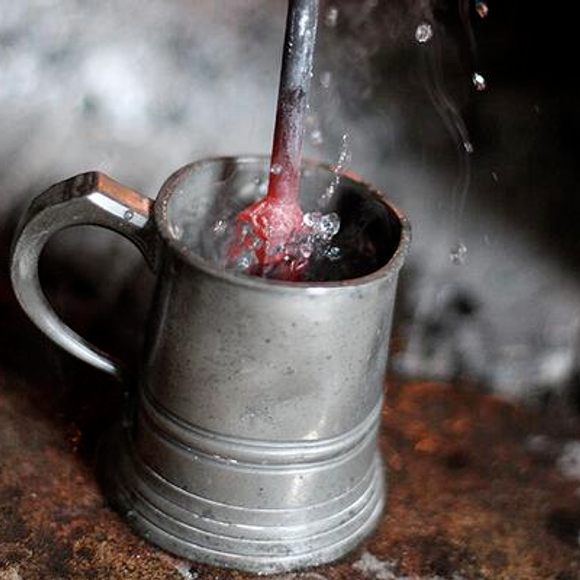
Typical recipes for mulled beer called for first infusing the herbs and spices in hot water, cooling, straining, and then adding the ‘liquor’ along with sugar, and sometimes cream and beaten eggs. The entire mixture was then heated again, often with a glowing poker drawn from the hot coals of a fire. Simplest of the mulled beers was ‘Aleberry’ made by heating beer to boiling, then adding sugar, spices, and topping all with floating sops of bread. No one set of spices was recommended, that was left to individual taste. Lambswool was another common drink. Popular in the 1700’s, preparation began by first roasting several apples until the skins burst. Strong, old ale was heated, into which nutmeg, ginger and sugar were thoroughly blended. Finally, the apples were immersed in the heated beer immediately before serving. Most well known of all the mulled beers was Wassail. Recipes for this holiday favorite vary, but all were based upon the same basic formula. Sugar was placed in the bottom of a bowl, one pint of warm beer was then poured in along with nutmeg, ginger and cinnamon. After all ingredients were infused the mixture was allowed to stand for several hours. When ready to serve it was heated and topped with several thin slices of toast.
As the 19th century progressed, mulled beers faded from view. With the introduction of lager beer and artificial refrigeration, cold beer could made available year-round. Americans embraced light, crisp, ice cold lagers pouring out of breweries. In the process, heated ales became ‘old-fashion’ and quickly disappeared.
Want to have the
Regimental Brewmeister
at your site or event?
You can hire me.
https://colonialbrewer.com/yes-you-can-hire-me-for-your-event-or-site/
 Michael Carver -- Historical Interpreter/Reenactor