On July 27, 1581, the newly formed Dutch Republic issued a declaration — Plakkaat van Verlatinghe, formally declaring the Netherlands’ independence from the King Philip II of Spain. The Seventeen Provinces of the Habsburg Netherlands were united by Holy Roman Emperor and King of Spain Charles V IN 1544. Under Charles, these provinces were governed as a separate entity set of feudal dukedoms under his Pragmatic Sanction of 1549 with each state in the Netherlands having its own semi-autonomous government; Duke of Brabant, Count of Holland etc. While there was never a single, unified state of the Netherlands, the States General of the Netherlands, behaved as a rough confederation of independent nations (sound familiar?).
With the religious intolerances of the Spanish Inquisition, the largely protestant Dutch eventually rebelled against the Church and sought a new prince — William of Orange (later to become King of Brittian) in the 1560s. Emerging as a Protestant country with tolerant laws, the Netherlands became a country of refuge for Jews, Muslims, and other displaced peoples following the 1492 Edict of Expulsion. With a history so clearly parallel, is it any wonder that Thomas Jefferson sought guidance for our Declaration of Independence in the history of the Netherlands?
“All these considerations give us more than sufficient reason to renounce the King of Spain, and seek some other powerful and more gracious prince to take us under his protection.” — Plakkaat van Verlatinghe, 1581
“In every stage of these oppressions, we have petitioned for redress, in the most humble terms. Our repeated petitions have been answered only by repeated injury. A prince, whose character is thus marked by every act which may define a tyrant, is unfit to be the ruler of a free people.” – Declaration of Independence, 1776
When the States General of the United Provinces of the Low Countries issued the Plakkaat van Verlatinge (Act of Abjuration), and argued that the actions of King Phillip II of Spain delegitimized his rule over the Low Countries, they justified that action in moral terms. Simply put, Phillip had abdicated his rights as ruler by playing the role of tyrant. Two hundred years later, Thomas Jefferson will “adapt” this language in a new Declaration of Independence, making almost the same arguments about George III of England. There has been much speculation about the ties between these two seminal documents, including claims that the authors of the Declaration used the Plakkaat as a model for the justification for the American Revolution.
Thomas Jefferson, the document’s chief author, was open about his review and adaptation of other documents when he was tasked with the job of drafting the Declaration of Independence. He adapted George Mason’s Virginia Declaration of Rights. He also borrowed freely from John Lock’s A Letter Concerning Toleration and Second Treatise of Government, Many believe much of the most memorable language of the Declaration of Independence is derived directly from Locke’s works. As Jefferson explained years later, he did not intend to “invent new ideas” or offer “no sentiment that had ever been expressed before.” We also know that Jefferson’s library at Monticello contained copies of the Plakkaat van Verlatinge.
The Plakkaat van Verlatinge, argues that when a “prince” does not “defend them from oppression and violence as the shepherd his sheep…. but, on the contrary, oppresses them, seeking opportunities to infringe their ancient customs and privileges, exacting from them slavish compliance, then he is no longer a prince, but a tyrant, and the subjects are to consider him in no other view. When this is done, the subjects may then legally proceed to the choice of another prince for their defense. Similarly, the Declaration of Independence, argues “when a long train of abuses and usurpations, pursuing invariably the same Object evinces a design to reduce them under absolute Despotism, it is their right, it is their duty, to throw off such Government, and to provide new Guards for their future security.” Both documents also include a catalogue of grievances and the documentation of repeated unsuccessful attempts to seek redress for these grievances, but for different reasons. Then end, however, remains the same, there is no option but revolution.
This logical construct, more than the actual wording (Jefferson spoke many languages but not Dutch) that served as a paradigm for the structure of the American Declaration of Independence. While the Dutch legal system did not have a framework for oaths of fidelity, such as marriage, the English system, thanks to Henry VIII, did so all Jefferson had to do was now merge the legal precedent of abdication with a list of abuses and usurpations to justify divorce and viola we have our Declaration of Independence.
Even the concluding list of signatures is preserved in both documents. In the American Declaration of Independence, we have the 57 signers from the Continental Congress. In the Plakkaat van Verlatinge, the dukes of each province (Brabant, Guelders, Flanders, Holland, Zeeland, Frisia, Mechelen, and Utrecht) signed the document and certify “we give to all and every one of you, by express command, full power and authority. In witness whereof we have hereunto set our hands and seals” that they stand behind the edict.
“You can’t fight nature, you can’t fight change, you can’t fight gravity, you can’t fight the sea but we have a plan.”
Plakkaat van Verlatinge (https://declarationproject.org/?p=1171)
Declaration of Independence (https://www.archives.gov/founding-docs/declaration-transcript)
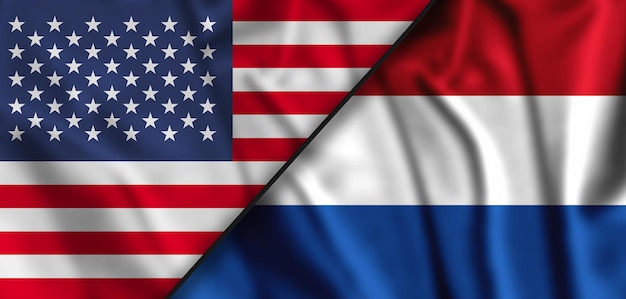
One last thought, have you considered the order in which we name our flag’s colors? The British flag has these same colors but no particular order (Scots will argue blue should be first). The Netherlands flag is clear – red, white, and blue!
Want to have the
Regimental Brewmeister
at your site or event?
You can hire me.
https://colonialbrewer.com/yes-you-can-hire-me-for-your-event-or-site/
 Michael Carver -- Historical Interpreter/Reenactor