Because of their abundance, the names pubs take were designed to be memorable—but more than that, they were designed to be visual. Outside any traditional pub worthy of its title, you’ll find a hanging signboard with a unique illustration that represents the name of the business. The first British pub signs were created in the 12th century and were simple representations of tankards, hops and other brewing-related paraphernalia used to inform passersby that the establishments sold ale. In an era when literacy was rare and most of the population were unable to read, pub signs were used to inform would-be customers that they could find a drink inside.
Public Houses, or Pubs, often also adopted lyrical names for their establishments meant to be memorable so that people could distinguish them from similar drinking outfits in growing towns. These names were often based not on the owner of the establishment, who might change over time, but on the icons displayed on the pub’s signage. People would arrange to meet “at the sign of the Eagle and Child” rather than “at the Eagle and Child.” Patrons may not have been able to distinguish the phrase “Hart and Stag” from “Bear and Staff,” but they could recognize a picture of these things whether they were a local or a passing traveler.
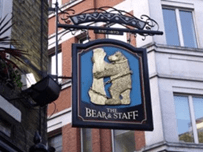
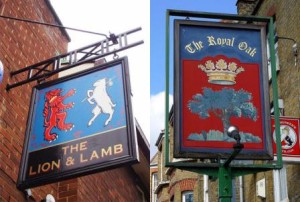
As well as being a unique identifier of an establishment, a pub’s sign was also an indicator of its license to operate. In 1393, King Richard II passed an act making it compulsory for pubs and inns to display his emblem, a White Hart, to identify them to the official ale taster, who would inspect the quality of the booze on sale. A law passed in 1431 said that if a pub owner didn’t display a sign, their ale could be seized. Records also show that if a pub owner’s license to sell ale was revoked, the pub’s sign was removed as a form of sanction. When King James I took the throne of both England and Scotland in 1603, he ordered that the heraldic red lion (one of Scotland’s emblems) be added to all important buildings, including pubs. As a result of these actions, the two most common pub names in the UK are still “The Crown” and “The Red Lion”.
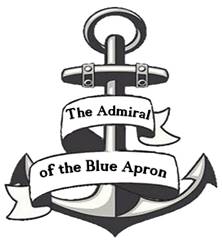
Today the tradition remains intact largely out of respect for the past, but many pub signs do retain some functionality. Remote country pubs often use signboards to point the way to their doors from more trafficked paths. Even the Regimental Brewmeister has a tavern sign. Mine is very loosely based on Thomas Flemings novel – Liberty Tavern – and my reenacting experience. In Francis Grose’s A Classical Dictionary of the Vulgar Tongue, first published in 1785, I found an entry that I have adopted as the moniker for my tavern impression: The ADMIRAL OF THE BLUE, is a publican wearing a blue apron, as was formerly the custom among gentlemen of that vocation. My persona in these taverns, like Jonathan Gifford of Liberty Tavern, a former British soldier, somewhat hobbled by a knee injury, who for the last decade has immersed himself in building his business. Like Gifford, I have HOISTED THE BLUE FLAG after leaving the service to create an Ordinary for my comrades.
Want to have the
Regimental Brewmeister
at your site or event?
You can hire me.
https://colonialbrewer.com/yes-you-can-hire-me-for-your-event-or-site/
 Michael Carver -- Historical Interpreter/Reenactor