

The larger end of a bird’s egg contains an air cell that forms when the contents cool and contract after the egg is laid. A freshly laid egg has a relatively small air cell, but the size increases with time since the shell is slightly porous. A fresh egg, however, is dense enough that it will sink in fresh water but if sugar or salt is dissolved in the water, the egg will begin to float once the specific gravity of the solution reaches a certain point. This makes an egg a primitive sort of hydrometer that can be used to concentration of a solution.
Specific gravity, in the context of brewing, refers to the relative density of the wort compared to that of water. Water (at sea level and 20°C) has a gravity of 1.000 whilst the original (starting) gravity the wort used to make beer is 1.040 to 1.120. In modern brewing we use a hydrometer to take a starting and a finishing gravity in order to calculate the alcohol content of the finished product, but the 18th Century brewer really only wanted to know the starting point of his brew as the fermentation then ran until it killed off all the yeast (FG~ 0.990 – 1.006).
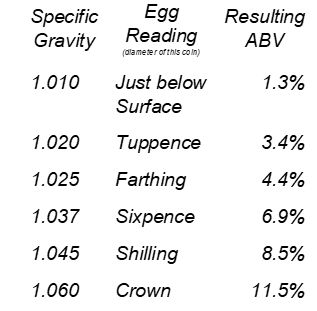
To use an egg as a hydrometer:
- Fill a standard beer mug with cooled (blood temperature) wort.
- Float an egg no more than 2 days old in the wort and observe the diameter of the egg that is exposed above the wort.
- Compare to the chart to the right.
The egg test is of course nowhere near as accurate as the use of a hydrometer or refractometer. When we brew 18th Century beers we only approximate ABV as the question is really not relevant to the tavern goers of 1770.
Want to have the
Regimental Brewmeister
at your site or event?
You can hire me.
https://colonialbrewer.com/yes-you-can-hire-me-for-your-event-or-site/

