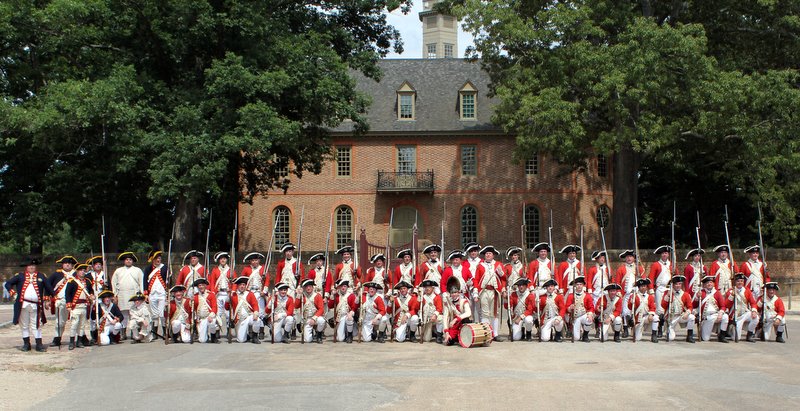
The British army punished its soldiers mercilessly. The purpose was to inspire terror by setting an example. Soldiers were frequently whipped leading to the derisive moniker “bloody backs” by which Redcoat soldiers were frequently known. The most common offence was drunkenness, which could merit 100 lashes. The sentence was carried out in front of the …
Author Archives: Michael Carver
How to Survey Land with 18th Century Tools — Using Napier’s Bones
In 1617, John Napier developed a mechanical method for performing multiplication and division using rods printed with simple multiplication tables. This method, eventually described as “Napier’s bones.” As the world’s first practical calculator, “Napier’s Bones,” can be used to multiply, divide and find simple square and cube roots. In a time when the average person …
Continue reading “How to Survey Land with 18th Century Tools — Using Napier’s Bones”
Historical Tidbits
When reenacting or acting as a historical interpreter, its good to have a few historical dates and stories to share. This series will publish a few. August 6, 1777 Battle of Oriskany and St. Leger The Battle of Oriskany occurred on August 6, 1777, when the local Tryon County Militia attempted to come to the …
Hire the Regimental Brewmeister for your Event or Site
Well, it’s finally winter and I have begun planning for 2026. If you want to book the Regimental Brewmeister in 2026, please contact me soon so we can block the calendar. I already have dates reserved for certain sites and my schedule fills quickly. If there is a date that you want to secure as …
Continue reading “Hire the Regimental Brewmeister for your Event or Site”
Practical Civil Disobedience
I know lots of you struggle with the idea of civil disobedience. Marches are easy but ineffective and easily ignored. Boycotts require enduring a bit of inconvenience and difficulty often equal to the effect they have on their intended target. None of these are good excuses for disengaging from the struggle but sometimes we need …
Joseph Priestly and Carbon Dioxide
In Leeds Joseph Priestley’s home was situated near a brewery. Whenever he walked by the brewery, Priestley observed an unusual phenomenon. He noticed that “fixed air” (carbon dioxide) was released in the process of fermentation and that this new “air” would extinguish burning pieces of wood and then drift to the ground. At home Priestley …
Historical Tidbits — Signing of the Declaration of Independence
When reenacting or acting as a historical interpreter, its good to have a few historical dates and stories to share. This series will publish a few. August 2, 1776 – Fifty-five members of the second Continental Congress met in Philadelphia to formally sign the Declaration of Independence. Benjamin Franklin is oft quoted as having said …
Continue reading “Historical Tidbits — Signing of the Declaration of Independence”
Historical Tidbits
When reenacting or acting as a historical interpreter, its good to have a few historical dates and stories to share. This series will publish a few. August 2, 1776 – Fifty-five members of the second Continental Congress met in Philadelphia to formally sign the Declaration of Independence. Benjamin Franklin is oft quoted as having said …
You Still Talk Funny
So, in my guise as “David Rittenhouse” for Historic Philadelphia, I meet all sorts. One prevalent of the query, however, “why, if you are part of British North America do you not speak with an accent?” I find this interesting for two reasons. Firstly, what was the accent in 1770? It clearly was NOT what …
Phlogiston and Fire — The Isolation of Oxygen
In the mid-18th century, the most pressing issue in chemistry and physics was to determine what exactly happens when something burns. The prevailing theory was that flammable materials contained a substance called “phlogiston” (from the Greek word for burn) that was released during combustion. The theory held that when a candle burned, for example, phlogiston …
Continue reading “Phlogiston and Fire — The Isolation of Oxygen”