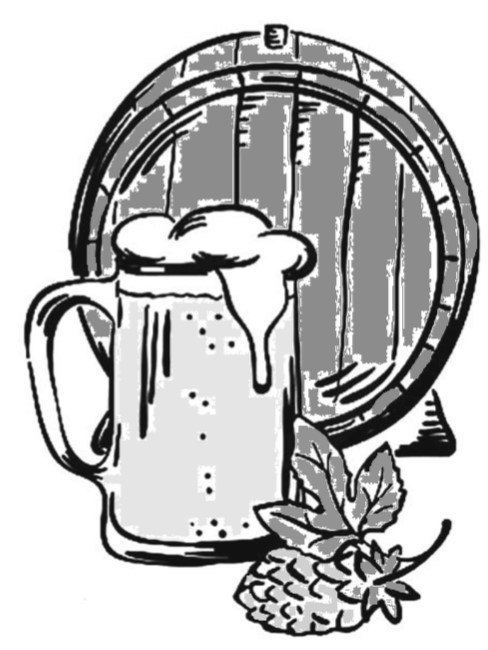
Okay this is weird but as the Regimental Brewmeister I feel compelled to inform you that the Mayo Clinic has suggested (not proved but only suggested) that may be preventative for Alzheimer’s Disease. For those of you who may have forgotten (pun intended), Alzheimer’s often causes memory loss and personality changes. It generally afflicts the …
Category Archives: Science
Historical Tidbits — The Lightning Experiment
When reenacting or acting as a historical interpreter, its good to have a few historical dates and stories to share. This series will publish a few. June 10, 1752 – Benjamin Franklin demonstrates that lightning is a form of electricity. This kite experiment will make Mr. Franklin one of the most famous men in the …
Continue reading “Historical Tidbits — The Lightning Experiment”
Historical Tidbits — Smallpox Vaccination.
When reenacting or acting as a historical interpreter, its good to have a few historical dates and stories to share. This series will publish a few. May 14, 1796 – Edward Jenner publishes his procedure for smallpox vaccination. His procedure differed from previous attempts at vaccination in that he injected a milder “attenuated” version of …
Continue reading “Historical Tidbits — Smallpox Vaccination.”
The dye that causes people to die
Wallpaper with Scheel Green In the mid-1700s, Carl Wilhelm Scheele discovered a copper derivative that was a particularly vivid green. Scheele’s discovery — known as Scheele’s Green — was used as a pigment for all sorts of artistic works, particularly among the European elite. Wallpaper, in particular, was made using Scheele’s Green to achieve the …
Happy π Day
Pi (often represented by the lower-case Greek letter π), one of the most well-known mathematical constants, is the ratio of a circle’s circumference to its diameter. For any circle, the distance around the edge is a little more than three times the distance across. Pi has interested people around the world for over 4,000 years. …
Eli Whitney Patented the Cotton Gin on March 14, 1794
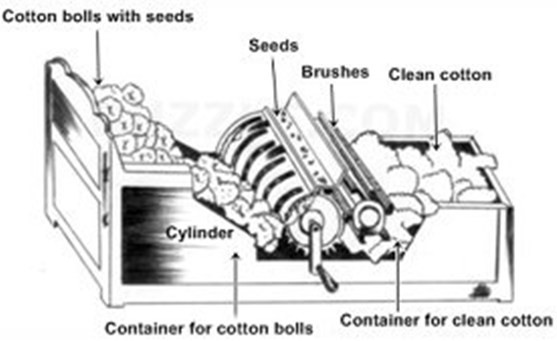
In 1794, U.S.-born inventor Eli Whitney patented the cotton gin, a machine that revolutionized the production of cotton by greatly speeding up the process of removing seeds from cotton fiber. By the mid-19th century, cotton had become America’s leading export. Despite its success, the gin made little money for Whitney due to patent-infringement issues. Also, …
Continue reading “Eli Whitney Patented the Cotton Gin on March 14, 1794”
Ben Franklin DID NOT Invent Daylight Savings Time!
Well, today we lose an hour of sleep to the interest of commerce. Don’t worry, you will get it back in November. Before the middle of the 19th Century, keeping time was more of an art than a science. Time pieces and clocks were available, even common in certain circles but they were notoriously inaccurate. …
Continue reading “Ben Franklin DID NOT Invent Daylight Savings Time!”
What’s in a Word?
Juliet: “What’s in a name? That which we call a rose By any other name would smell as sweet.” Last year, Lake Superior State University in Sault St. Marie continued its decades-long tradition of banishing a list of popular words from the previous year. To determine the words to be cut, they asked for nominations …
Beer is Good for You
Okay this is weird but as the Regimental Brewmeister I feel compelled to inform you that the Mayo Clinic has suggested (not proved but only suggested) that may be preventative for Alzheimer’s Disease. For those of you who may have forgotten (pun intended), Alzheimer’s often causes memory loss and personality changes. It generally afflicts the …
Edmund Halley’s Famous Prediction
The first known observation of Halley’s Comet, or Comet Halley, took place in 239 BCE., when Chinese astronomers recorded its passage in the Shih Chi and Wen Hsien Thung Khao chronicles. When Halley’s returned in 164 BCE. and again in 87 BCE, it was noted in Babylonian records. It’s also thought that another appearance of …