Phlogiston and Fire — The Isolation of Oxygen

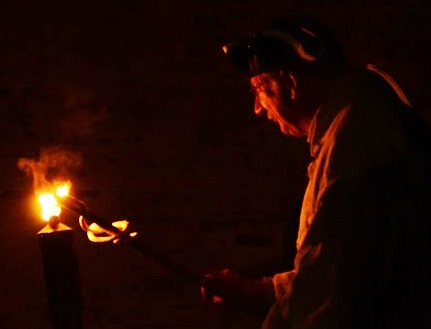
In the mid-18th century, the most pressing issue in chemistry and physics was to determine what exactly happens when something burns. The prevailing theory was that flammable materials contained a substance called “phlogiston” (from the Greek word for burn) that was released during combustion.  The theory held that when a candle burned, for example, phlogiston …

The Yeast Ring

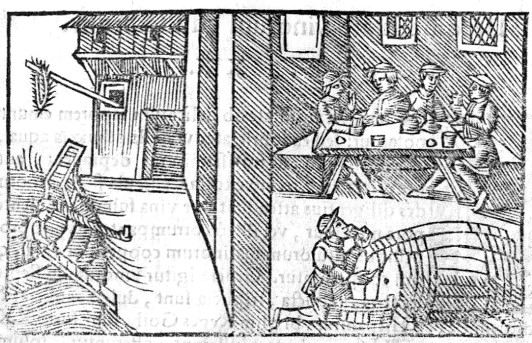
This year, I am adding a somewhat archaic bit of brewing equipment to the gear brought out by the Regimental Brewmiester.  The yeast ring or gjarkrans is a piece of traditional brewing gear from medieval Sweden and Denmark.  This tool resembles a complicated wreath of small pieces of whittled wood.  Yeast harvested from one batch …

The Invention of the Thermometer

Every time I give a brewer’s presentation, I must remind the various homebrewers who come to these events that a thermometer would have been an EXPENSIVE and rare instrument in the 18th Century.  Today they are ubiquitous, even my car has a built-in thermometer, but in 1750 these would have been delicate and hard to …

American Historical Mythology

If you hang around Fort Mifflin very long you will, no doubt, be regaled with stories of the supernatural and the pseudoscience that supports its existence. These are all good fun but let’s be clear, SOME people actually believe these things and even though the scientifically minded dismiss THESE beliefs, they are quick to then …

Colonial Market Fair at Benjamin Banneker House

Largely self-taught, Banneker was one of the first African Americans to gain distinction in science. His significant accomplishments include the successful prediction of a solar eclipse, publishing his own almanac, and the surveying of Washington, D.C. Banneker spent most of his life on his family’s 100-acre farm outside Baltimore. There, he taught himself astronomy by …

Historical Tidbits

When reenacting or acting as a historical interpreter, its good to have a few historical dates and stories to share. This series will publish a few. May 14, 1796 – Edward Jenner publishes his procedure for smallpox vaccination.  His procedure differed from previous attempts at vaccination in that he injected a milder “attenuated” version of …

The danger of always marching in lockstep

If you’ve ever been part of an organization that marches — not just the military but even marching bands and re-enactors (sort of) — you know what it means to march in lockstep.  Everyone steps in precision to a standard cadence (usually 120 steps/min, 28 in/step) and one person takes a step with his left …

The dye that causes people to die

Wallpaper with Scheel Green In the mid-1700s, Carl Wilhelm Scheele discovered a copper derivative that was a particularly vivid green. Scheele’s discovery — known as Scheele’s Green — was used as a pigment for all sorts of artistic works, particularly among the European elite. Wallpaper, in particular, was made using Scheele’s Green to achieve the …

Basic Colonial Brewing #5 –Why use Copper?

Go to almost any brewery or distillery and you will see lots of gleaming copper. This is not some quaint historical holdover nor is it there for show. We use copper in brewing for real and practical purposes. The reasons for using copper were well understood by the Colonial Brewer but why it worked has …