
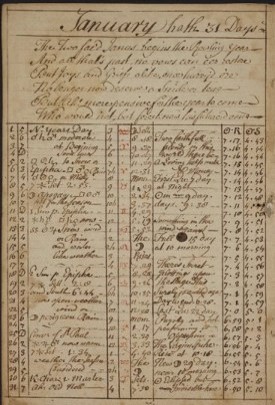
David Rittenhouse had a long and varied career. He was, of course, Philadelphia’s most celebrated astronomer but he was also a clockmaker, an inventor, the treasurer of the Continental Congress, City Surveyor of Philadelphia, and founder of the US Mint. His masterful 1771 Orrery was the state of the art in teaching celestial mechanics for first half of the 19th century, he was the 2nd President of the American Philosophical Society. It should come as no surprise to learn that like Benjamin Franklin, Thomas Jefferson, and Benjamin Banakker also tried his hand at writing an almanac.
In 1747, when David Rittenhouse was only 15 years old, he composed a set of lunar tables into an almanac. As a teenager, it was reported that wherever David was sent to work, the fences and plows with which he used would later be found covered with notations and mathematical formulas.
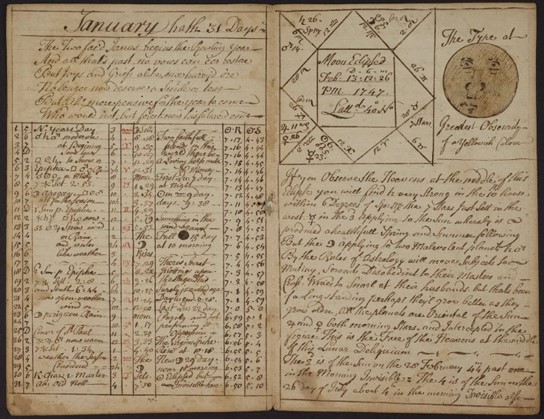
Almanacs were ubiquitous in colonial America. They provided essential information including about weather, planting dates, and tide tables arranged in a calendar. Popular almanacs, like Poor Richards, might contain essays, tools for making financial calculations, political commentary, and information about the local community. Nearly every household owned a copy of one or more almanacs, and these were meant to be carried around and referenced much like we carry our smartphones today.
These pocketbooks held lots of commonly used information, most of which was simply collected by the author from various sources and reorganized. Computations, however, were more difficult and had to be created by a credible mathematician or astronomer so the books could be used to local time, adding or subtracting readings from a sundial to match the time of year. These computations also predicted phases of the moon, tides (critical to seafarers), and sunrise and sunset. Since mechanical timepieces could be temperamental, many colonists relied on this paper counterpart to ensure they thse devices were reset as needed.
It is this element of the almanac we find in David’s hand. Many potential astronomers and surveyors built the timetables in almanacs, generally for another less mathematically inclined publisher (like Franklin) to master the computations. This is what we find in Rittenhouse’s 1747 almanac. It was never published nor embellished with all the extras we find in Franklin’s masterpieces, this was a simple four page set of charts and timetables predicting the movements of the heavens and the seas. All written by a 14-year-old because he was bored. As we enter the summer, remind your kids, boredom can lead to great discoveries.
This almanac can be found at the University of Pennsylvania Library.
Want to have the
Regimental Brewmeister
at your site or event?
You can hire me.
https://colonialbrewer.com/yes-you-can-hire-me-for-your-event-or-site/
 Michael Carver -- Historical Interpreter/Reenactor