
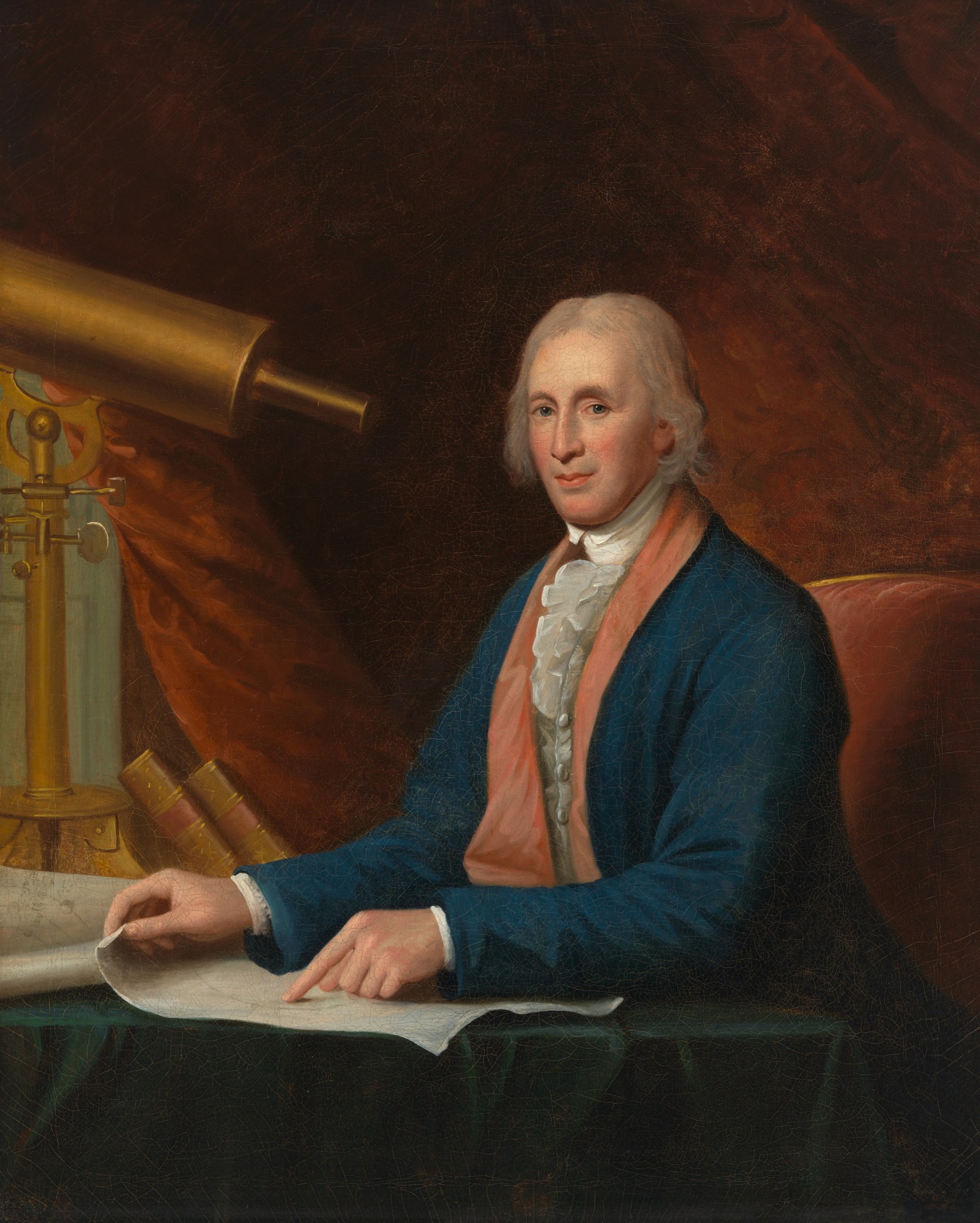
In 1767, the American astronomer and mathematician David Rittenhouse (1732-1796) described a pocket thermometer that contained a bimetallic mechanism. Bimetallic or deformation thermometers depended on different expansion rates of two metal strips set into a curl. As the temperature changed, the curvature of the metal curls also changed and moved a pointer along a marked temperature scale.
Rittenhouse was studying the variations in the oscillations of the pendulum, caused by the expansion and contraction of the material of which it is made. This variation causes inaccuracies in any mechanical chronometer. David devised a plan to compensate for temperature variations by attaching a bent tube of glass to the pendulum a bent tube of glass and partially filling this tube with alcohol and mercury. It did not work.
Later that year, however, he made a thermometer based upon the principle of the expansion and contraction of metals. An index moved upon a flat surface over a semicircle, which was graduated according to the Fahrenheit degrees of temperature. Rittenhouse published his design but never pursued refinement, instead focusing on the orreries he was building for Princeton and University of Pennsylvania. In the early 1800’s, Louis-Clément Breguet has obtained much reputation by “inventing” anew this forgotten instrument using information he found published in the Proceedings of the Royal Society.
Bimetallic thermometers are more durable and more sensitive over a higher range of temperatures than mercury thermometers.
Want to have the
Regimental Brewmeister
at your site or event?
You can hire me.
https://colonialbrewer.com/yes-you-can-hire-me-for-your-event-or-site/

