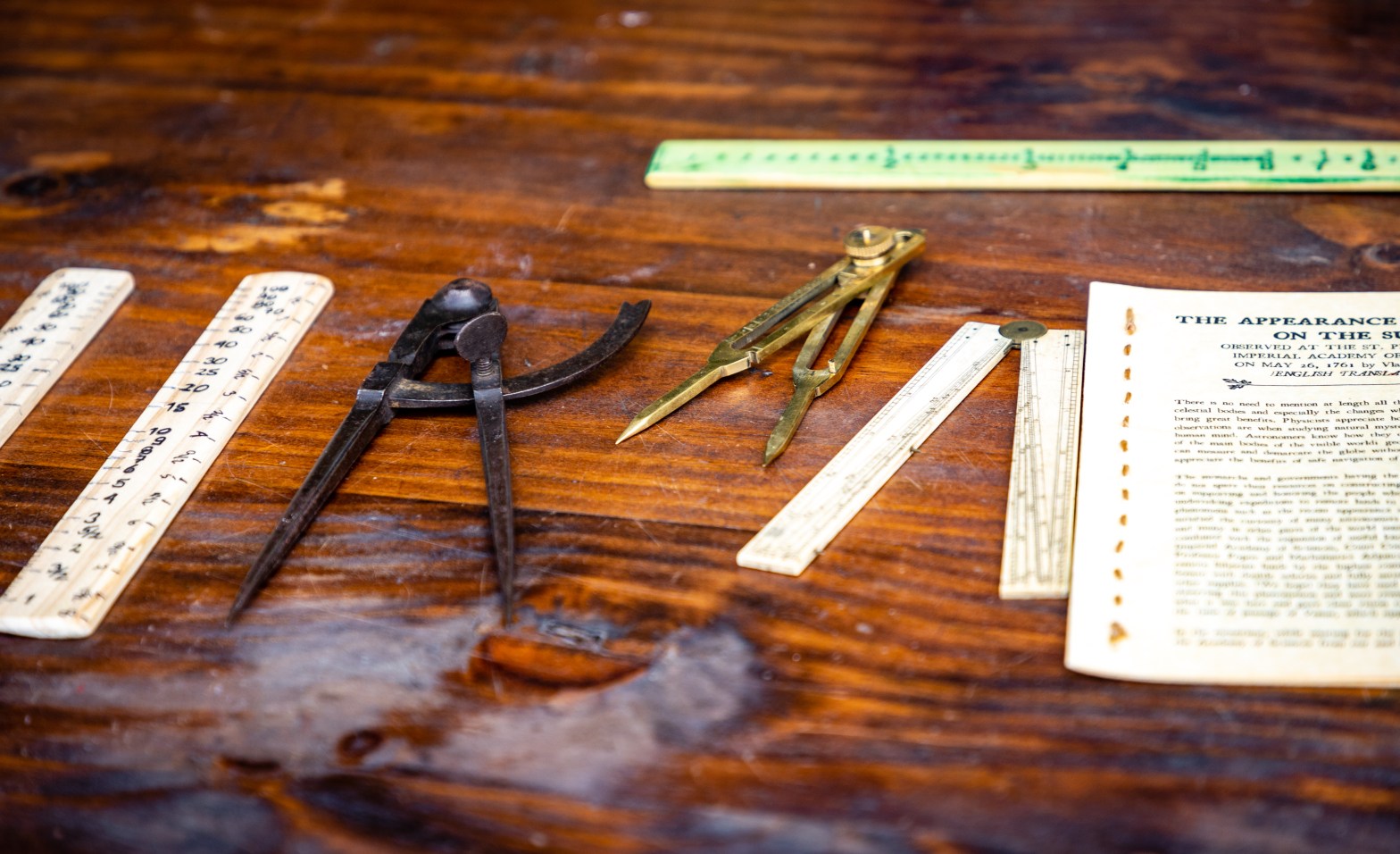
An alidade is a device that allows one to sight a distant object and use the line of sight to perform a task, like recording a line on a map. These devices are often incorporated into other tools like the surveyor’s compass or circumferentor but can also be used independently on the plane table. The …
Author Archives: Michael Carver
Tools of the Surveyor — Gunter’s Chain
Developed by Edmund Gunter in 1620, Gunter’s chain sought to reconcile traditional English land measurements, based on the number 4, with the decimal system. Each chain was composed of 100 links, measuring 66 feet total (each link measures 7.92 inches long). A chain is subdivided into four parts—each made up of 25 links measuring 5 …
Tools of the Surveyor — The Artificial Horizon
A surveyor’s artificial horizon is a device developed by London instrument maker John Elton in 1732, this tool (traditionally a tray of mercury but this can be oil, water, or a specialized mirror) allows “for taking altitudes without a horizon.” With the artificial horizon, precise latitude readings may be taken with a sextant when a …
Continue reading “Tools of the Surveyor — The Artificial Horizon”
Tools of the Surveyor — Carver’s Quadrant
The quadrant is an instrument used to simplify astronomical calculations and to make observations. Developed by Isaac Carver, a student of Edmund Gunter, in 1706. The quadrant is used to observe and measure astronomical phenomena, to perform the basic tasks of surveying. Designed to work at specific latitudes (in this case 38-41 N), the quadrant …
Continue reading “Tools of the Surveyor — Carver’s Quadrant”
Tools of the Surveyor — Gunter’s Rule
Gunter’s Rule was invented by Edmund Gunter in 1620 to operationalize the work John Napier did with Logarithms. Napier published a table of logarithms in 1614 with which one can replace complex multiplication and division with simpler addition and subtraction of the equivalent logarithms. This is an improvement if you must calculate by hand but …
An Egg as Hydrometer

The larger end of a bird’s egg contains an air cell that forms when the contents cool and contract after the egg is laid. A freshly laid egg has a relatively small air cell, but the size increases with time since the shell is slightly porous. A fresh egg, however, is dense enough that it …
The 1769 Transit of Venus was Used to Compute the Astronomical Unit
In a 1716 issue of the Philosophical Transactions of the Royal Society, Edmund Halley explained how it was possible to use transits of Venus or Mercury to determine the astronomical unit by measuring the apparent solar parallax between different points on the surface of the Earth. Unfortunately, the next transits would occur in 1761 and …
Continue reading “The 1769 Transit of Venus was Used to Compute the Astronomical Unit”
The Beer was Not Cold

Before the invention of modern refrigeration, people rarely drank anything ice-cold. Beer was traditionally drunk it at “room temperature” or cellar temperature. Drinking any “ice-cold” beverage was a rare luxury reserved only for the extremely wealthy who would harvest and store natural winter ice in deep cellars. In the German states[1] beer was fermented and …
Early Meteorology — The Deflection Anemometer
Wind is perhaps one of the most obvious weather phenomena and was of critical importance to commerce in the 18th Century. Wind propels not just ships at sea but the earliest industrial processes like milling grain and pumping water (especially in the Netherlands).There is some controversy over the invention of the anemometer. Some historians suggest …
Continue reading “Early Meteorology — The Deflection Anemometer”
Early Meteorology — Goethe’s Barometer
The weather glass is a small open barometer filled with water. It is a simple instrument designed to indicate atmospheric pressure rises and falls as the water in its spout falls or rises. It does not provide quantitative measurements of atmospheric pressure but indicates changes. Falling water in the glass (water pushed into the sealed …

