Tools of the Surveyor — The Surveyors’ Compass or Circumferentor

A circumferentor, or surveyor’s compass, is used to measure horizontal or magnetic bearings for lines laid out in a survey.  It consists of a box containing a magnetic needle, which moves freely over compass rose divided into 360 degrees and a pair of sights located on the North-South axis of the compass.  Circumferentors were typically …

Tools of the Surveyor — The Astrolabe

Before we had sextants and octants, celestial navigation was accomplished using the astrolabe.  Originating in Greece and perfected by medieval Islamic scholars, this astronomical “multi-tool” and rudimentary analog computer revolutionized navigation, timekeeping, and astronomy before being replaced by the sextant and pendulum clock. Want to have the Regimental Brewmeister at your site or event? You …

Tools of the Surveyor — The Sextant and the Octant

In 1730 Thomas Godfrey of Philadelphia invented what was referred to as a double reflecting sextant.  At the same time, entirely independent of Godfrey, John Hadley, an English mathematician and astronomer, invented the Hadley’s Quadrant which was also a double reflecting.  Both instruments were equipped with half mirrors and sights.  Latitude measurements were taken by …

Tools of the Surveyor — Gunter’s Chain

Developed by Edmund Gunter in 1620, Gunter’s chain sought to reconcile traditional English land measurements, based on the number 4, with the decimal system. Each chain was composed of 100 links, measuring 66 feet total (each link measures 7.92 inches long). A chain is subdivided into four parts—each made up of 25 links measuring 5 …

Tools of the Surveyor — The Artificial Horizon

A surveyor’s artificial horizon is a device developed by London instrument maker John Elton in 1732, this tool (traditionally a tray of mercury but this can be oil, water, or a specialized mirror) allows “for taking altitudes without a horizon.” With the artificial horizon, precise latitude readings may be taken with a sextant when a …

Tools of the Surveyor — Carver’s Quadrant

The quadrant is an instrument used to simplify astronomical calculations and to make observations.  Developed by Isaac Carver, a student of Edmund Gunter, in 1706. The quadrant is used to observe and measure astronomical phenomena, to perform the basic tasks of surveying. Designed to work at specific latitudes (in this case 38-41 N), the quadrant …

Tools of the Surveyor — Gunter’s Rule

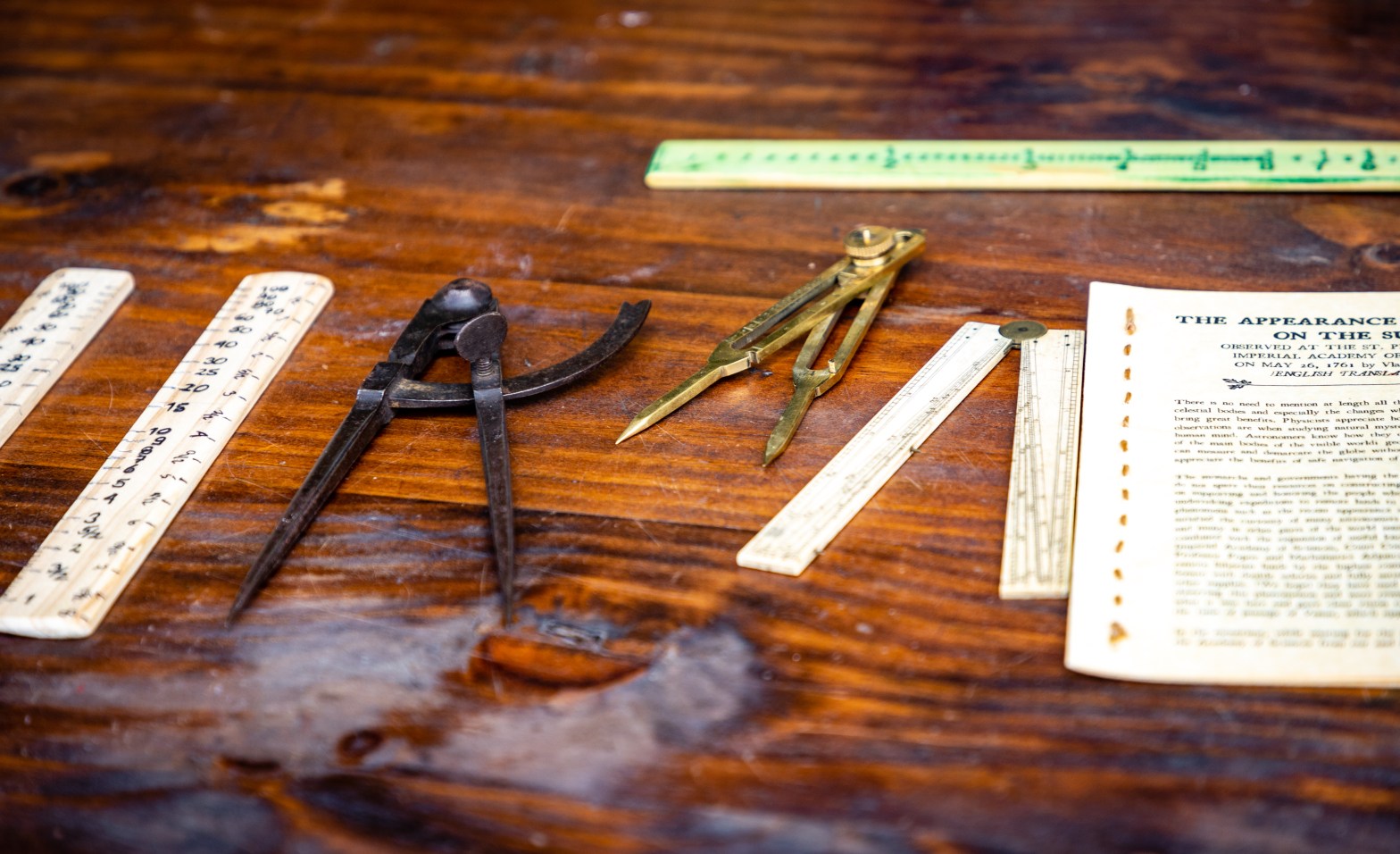
Gunter’s Rule was invented by Edmund Gunter in 1620 to operationalize the work John Napier did with Logarithms. Napier published a table of logarithms in 1614 with which one can replace complex multiplication and division with simpler addition and subtraction of the equivalent logarithms.  This is an improvement if you must calculate by hand but …